
Introduction: Bridging Engineering and Biology
Biomechanics is the intersection of engineering mechanics and biological systems. It is the scientific discipline dedicated to analyzing the mechanical forces (stress, strain, motion) generated by, or applied to, biological tissues, medical devices, and human-machine interfaces. In the commercial and clinical world, biomechanics laboratory testing is not merely academic; it is the fundamental process that validates product design, ensures patient safety, and predicts component longevity under real-world conditions.
From confirming the durability of an artificial hip implant to optimizing the kinetic efficiency of a running shoe, biomechanical analysis provides quantitative, defensible data required for regulatory approval (e.g., FDA clearance) and market release. For medical device manufacturers, sports technology developers, and specialized contract laboratories, understanding the specific testing modalities and instrumentation is paramount to translating design concepts into reliable, functional products.
This comprehensive guide delves into the core testing principles, critical application areas, and the specialized equipment utilized in the biomechanics laboratory to ensure material and functional performance.
Part I: Core Testing Modalities and Principles
Biomechanics testing relies on fundamental engineering tests adapted for biological materials and complex anatomical structures. These tests measure the mechanical properties—stiffness, strength, flexibility, and fatigue life—of materials ranging from synthetic polymers and metals to bone, cartilage, and soft tissues.
1. Static Mechanical Testing (Tensile and Compression)
These tests evaluate material properties at a single, controlled strain rate, providing data on ultimate strength and stiffness.
- Tensile Testing: Measures a material’s resistance to being pulled apart. In biomechanics, this is crucial for evaluating ligaments, tendons, or the pull-out strength of surgical sutures and anchors. The data yields the Young’s Modulus (stiffness) and Ultimate Tensile Strength (maximum load before failure).
- Compression Testing: Measures a material’s resistance to forces pushing it together. This is essential for studying load-bearing components like vertebral cages, spinal implants, and intervertebral discs. The results determine the material’s yield strength and elastic limit under crushing forces.
- Flexural Testing (Bending): Measures a material’s ability to resist deformation under bending load. This is critical for bone plates, dental fixtures, and orthopedic rods that encounter complex, non-axial forces in vivo.
2. Dynamic Mechanical Testing (Fatigue and Wear)
Biological systems are rarely static; components are subjected to millions of loading cycles over their lifetime. Dynamic testing simulates this long-term wear and tear.
- Fatigue Testing: Simulates the cumulative damage caused by repetitive loads well below the material’s ultimate strength. Fatigue failure is the primary failure mode for metal implants (e.g., joint stems, screws). Tests subject the component to cyclic loading (e.g., $10^7$ cycles) to determine the material’s endurance limit or expected lifespan.
- Wear Testing: Measures the degradation and material loss caused by relative motion between two contacting surfaces. For hip and knee replacements, this is the most critical test, simulating years of gait cycles. Specialized joint simulators recreate the temperature, lubrication (using serum), and multi-axial motion to quantify particulate debris generation, which is a major factor in implant loosening and failure.
3. Torsion Testing
Measures a component’s resistance to twisting forces. This is vital for fixation screws, connecting rods, and dental components that encounter rotational moments. Torsion testing determines the material’s shear modulus and maximum angle of twist before failure.
Part II: Key Application Areas and Standards
Biomechanics testing is governed by stringent international standards, primarily from ASTM International and the International Organization for Standardization (ISO), which define the precise testing environment and methodology required for specific devices.
1. Orthopedic and Joint Implants
Implants must withstand cyclic loading equivalent to walking and running over decades.
- ISO 14242 (Hip) and ISO 14243 (Knee): These standards specify the exact load waveforms, frequencies, and lubrication required for wear testing in joint simulators, ensuring data is globally comparable for regulatory submission.
- ASTM F2077: Standardized test method for measuring the mechanical properties of intervertebral body fusion devices (spinal cages).
- ASTM F543: Specifies the necessary dimensions and testing requirements for metallic medical bone screws.
2. Dental Biomechanics
Dental components must withstand high chewing forces and complex, multi-directional motion. Testing focuses on the bond strength of restorative materials, the fatigue life of crowns and bridges, and the osseointegration strength of dental implants.
3. Soft Tissue and Tissue-Engineered Products
Testing biological tissue (like skin grafts, heart valves, or ligaments) is complex because their properties are viscoelastic—meaning their response is time- and rate-dependent.
- Viscoelasticity Testing: Requires precise dynamic mechanical analysis (DMA) to measure the material’s elastic (stiffness) and viscous (energy dissipation) components across varying frequencies, providing a far more accurate model than static tests alone.
- Biomaterial Scaffolds: Contract laboratories test engineered tissue scaffolds for porosity, degradation rate, and mechanical integrity to ensure they support cellular growth without premature collapse.
4. Sports and Automotive Safety
- Head and Neck Biomechanics: Testing helmets, restraints, and protective gear often involves replicating injury scenarios using crash test dummies or Hybrid III anthropomorphic test devices (ATDs). Data capture includes high-speed cameras and accelerometers to quantify injury metrics such as the Head Injury Criterion (HIC).
- Ergonomics and Kinetics: Contract laboratories utilize motion capture systems and force plates to analyze human gait, posture, and muscle activation patterns to optimize athletic performance equipment (e.g., shoe design, cycling dynamics).
Part III: Specialized Instrumentation and Data Analysis
The accuracy and defensibility of biomechanical data hinge on using specialized, high-precision, and calibrated testing equipment.
1. Universal Testing Machines (UTMs)
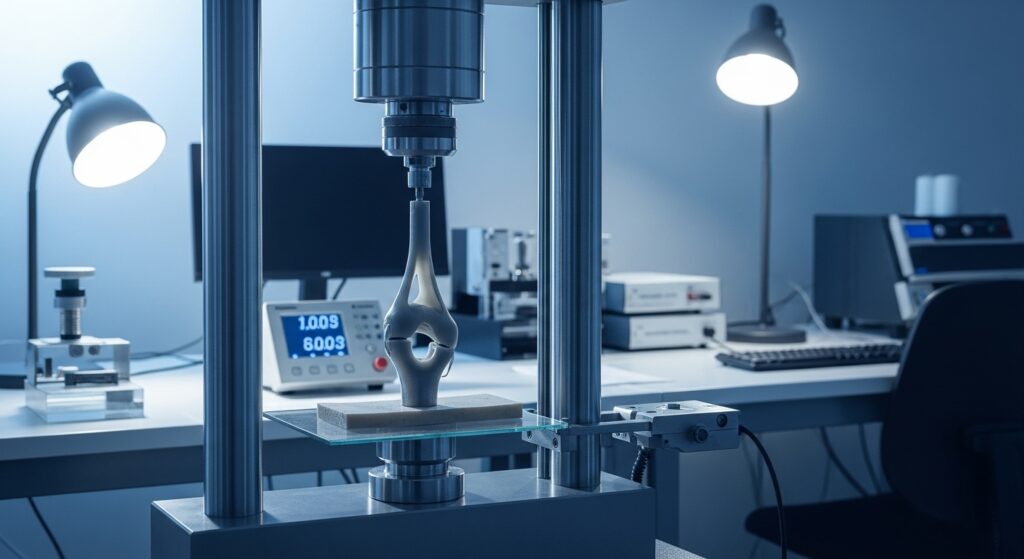
The core tool of the lab, a UTM, provides precise control over displacement and load application. Biomechanical UTMs feature:
- High-Resolution Load Cells: Capable of accurately measuring forces ranging from a few Newtons (for soft tissues) up to hundreds of kilonewtons (for bone and metal implants).
- Environmental Chambers: Required for in vitro testing to simulate the human body environment, maintaining strict control over temperature (37 °C) and humidity, often using saline solution or bovine serum.
2. Joint Simulators and Multi-Axial Load Frames
Advanced dynamic testing requires complex machines capable of simultaneous, independent control over multiple axes of motion and force.
- Joint Simulators: Specifically designed to replicate the six degrees of freedom of human joints (e.g., flexion/extension, abduction/adduction, internal/external rotation) while applying physiological forces. They are essential for regulatory wear testing of total joint replacements.
- Spinal Load Frames: Used to apply complex combined loads—compression, torsion, and flexion—to spinal components, simulating bending, lifting, and twisting movements.
3. Non-Contact Measurement
Biological tissues often deform significantly during testing, making traditional contact extensometers impractical. Digital Image Correlation (DIC) and high-speed videography are used to track surface features on the material, providing non-contact, full-field strain maps and allowing for non-destructive analysis of tissue deformation.
Part IV: The Contract Laboratory’s Technical Value
Biomechanics testing requires immense capital investment, specialized engineering staff, and rigorous adherence to complex, evolving standards. The contract laboratory provides crucial technical solutions that mitigate regulatory and product risk.
V&V and Regulatory Compliance
The contract laboratory acts as a partner in Verification and Validation (V&V). They execute standardized tests that generate the verifiable data needed for regulatory submissions to the FDA (e.g., 510(k) clearance) or international bodies. Their ISO/IEC 17025 accreditation is mandatory, ensuring that all load frames, sensors, and environmental controls are traceable and calibrated, guaranteeing the data’s integrity during regulatory audit.
Custom Fixturing and Method Development
Many novel medical devices (especially patient-specific or additively manufactured implants) do not fit existing standard test methods. A key capability of the specialized contract lab is custom fixturing design and methodology modification. This involves designing and validating bespoke grips, environmental chambers, and test protocols to accurately replicate the in vivo loading conditions and biological environment relevant to the unique device.
Failure Analysis
When an implant or device fails in the field, the contract laboratory performs Failure Analysis. Using techniques like scanning electron microscopy (SEM) for fracture surface examination and elemental analysis (EDS) for material verification, they determine the root cause—whether it was due to material fatigue, metallurgical defect, or inappropriate surgical installation—providing vital forensic data for litigation or product improvement.
Conclusion: Data as the Determinant of Safety
Biomechanics laboratory testing is an indispensable process that governs the safety and efficacy of products ranging from life-critical orthopedic devices to performance-enhancing athletic gear. This discipline relies on specialized dynamic testing, such as fatigue and wear simulation, to accurately predict component lifespan under complex physiological conditions. Adherence to standards like ISO 14242 and ASTM F2077 is the technical requirement for market entry.
Manufacturers must engage ISO/IEC 17025 accredited contract laboratories to access the necessary expertise, specialized joint simulators, and high-precision UTMs. This partnership provides not only the certified data required for regulatory V&V but also the forensic analysis necessary to understand material failure, ultimately ensuring that engineered solutions are safe, reliable, and functional when they interface with the human body.
If your organization requires certified biomechanics testing, including fatigue analysis, joint wear simulation, or V&V testing for orthopedic and medical devices, submit your testing request today and connect with our network of accredited biomechanics laboratories.