
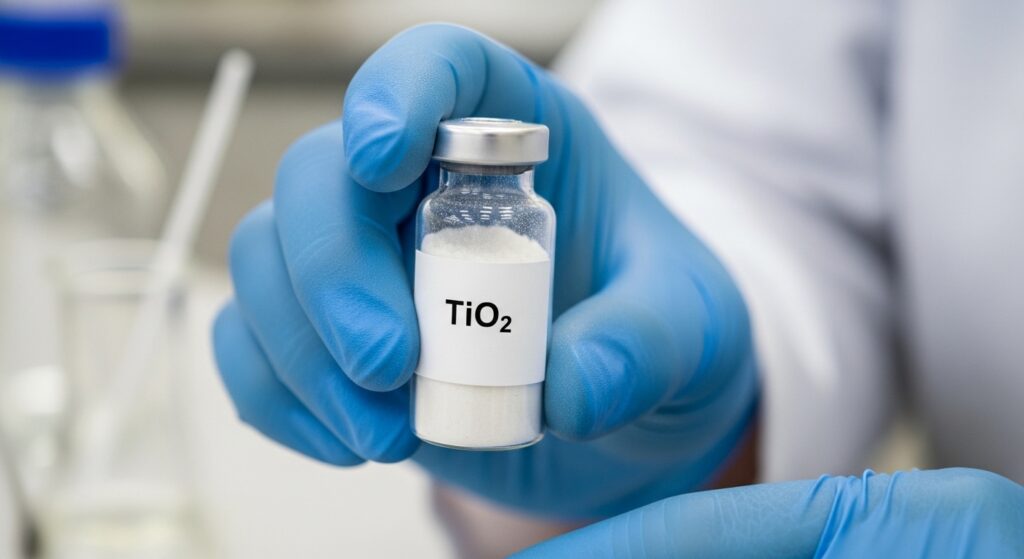
For decades, Titanium Dioxide (E171) was the industry standard for creating bright white confectionery, bakery frostings, and sauces. However, the European Union’s recent ban on E171 as a food additive—driven by EFSA’s concerns over genotoxicity and nanoparticle accumulation—has sent shockwaves through the global supply chain. For US-based manufacturers exporting to Europe, the mandate is clear: reformulate or lose market access.
Replacing a pigment known for its stability and opacity is difficult enough, but the compliance challenge goes deeper. Manufacturers must not only remove TiO2 but also prove through rigorous Titanium Dioxide (TiO2) analysis that their new “clean” recipes are free from cross-contamination and that their natural substitutes haven’t introduced new risks.
The Hidden Risks of Natural Alternatives
As brands rush to swap E171 for calcium carbonate, rice starch, or other natural whiteners, they often encounter unforeseen quality control issues. The assumption that “natural” means “pure” can be a costly mistake. For instance, rice starch, a popular clean-label opacifier, is susceptible to bioaccumulating arsenic and cadmium from soil water. Similarly, mined mineral alternatives like calcium carbonate can carry naturally occurring lead if not sourced from high-purity, food-grade deposits.
Bronte Ushaglan, Food Scientist and President of United Food Labs, explains the specific analytical hurdles manufacturers face during this transition:

“When a company removes titanium dioxide, the biggest challenge is proving the replacement doesn’t introduce hidden contaminants. Some natural whitening agents can still contain trace heavy metals, which can’t be detected without targeted testing. The targeted testing needs to have a very low detection to be able to see the trace amounts.”
This underscores the need for a dual-track testing strategy: verifying the absence of TiO2 while simultaneously screening new ingredients for heavy metals like lead and arsenic.
The Nanoparticle Challenge: Testing Beyond Chemistry
The EU’s regulatory crackdown was largely precipitated by the behavior of TiO2 nanoparticles. Consequently, verifying compliance isn’t just about chemical composition; it’s about physical structure. Standard chemical screens might identify what is in your product, but they often fail to capture the particle size distribution that regulators are scrutinizing. This is complicated by the tendency of nanoparticles to agglomerate (clump together) in food matrices, effectively hiding their “nano” status from simpler tests.
When asked how to validate these complex matrices, Ushaglan emphasized the need for advanced microscopy:
“Testing for nanoparticles requires methods that measure particle size, not just chemical composition. Common techniques include electron microscopy, dynamic light scattering, or particle size distribution analysis. Sample preparation is critical because nanoparticles can clump together or break apart. The test method must match how the material exists in the finished product.”
Technical Validation: Chemical vs. Physical Analysis
To ensure E171 compliance, exporters typically require a combination of analytical techniques that function as a “Screen and Confirm” protocol. A simple chemical test can confirm the presence of Titanium, but understanding the particle morphology requires physical imaging.
| Method | Application | Why it Matters |
|---|---|---|
| ICP-MS (Inductively Coupled Plasma Mass Spectrometry) | Elemental Analysis | Quantifies total Titanium content to verify “Zero TiO2” claims. |
| SEM/TEM (Scanning/Transmission Electron Microscopy) | Particle Visualization | visualizes nanoparticles to determine size and shape compliance. |
| Dynamic Light Scattering (DLS) | Size Distribution | Measures how particles behave in suspension (crucial for beverages/sauces). |
Why Third-Party Lab Testing is Critical for Exporters
In the context of the E171 ban, relying solely on an internal “recipe change” document or a supplier’s affidavit is insufficient for EU customs officials or major international retailers. The legacy of Titanium Dioxide in manufacturing facilities presents a significant, invisible risk. Because TiO2 is an extremely fine, persistent powder that adheres tenaciously to stainless steel and mixing equipment, facilities that have processed it for years often retain microscopic residues in gaskets, valves, and air handling systems. Even if the ingredient has been formally removed from the recipe, these “ghost” particles can cross-contaminate new batches, triggering a positive test result at the border. EU regulators are testing for the physical presence of the substance, not just the intent of the formulation.
The Value of Independent Certification:
- Cross-Contamination Audits: Third-party swabbing and analysis can detect residual TiO2 dust on manufacturing lines that might contaminate “clean” batches.
- Regulatory Documentation: A comprehensive Certificate of Analysis (COA) demonstrating non-detectable levels of Titanium is the passport your product needs to enter the EU market.
- Heavy Metal Screening: Independent labs can validate that your new starch or mineral-based whiteners meet the strict purity standards required for baby food and confectionery.
Final Checklist: Is Your Reformulation EU-Ready?
- [ ] Ingredient Audit: Have you screened your new natural whiteners for heavy metals?
- [ ] Line Validation: Have you tested your mixing and packaging lines for residual TiO2?
- [ ] Particle Analysis: If using mineral alternatives, have you characterized the particle size distribution?
- [ ] Documentation: Do you have a recent COA from an accredited lab verifying “Non-Detect” for Titanium?
The global recipe has changed. Ensuring your product meets these new standards requires precision, science, and the right testing partner.
Does your reformulated product meet E171-free standards? Visit Contract Laboratory to find a qualified laboratory, or Submit a Testing Request to get competitive quotes for your Titanium Dioxide (TiO2) analysis needs today.