
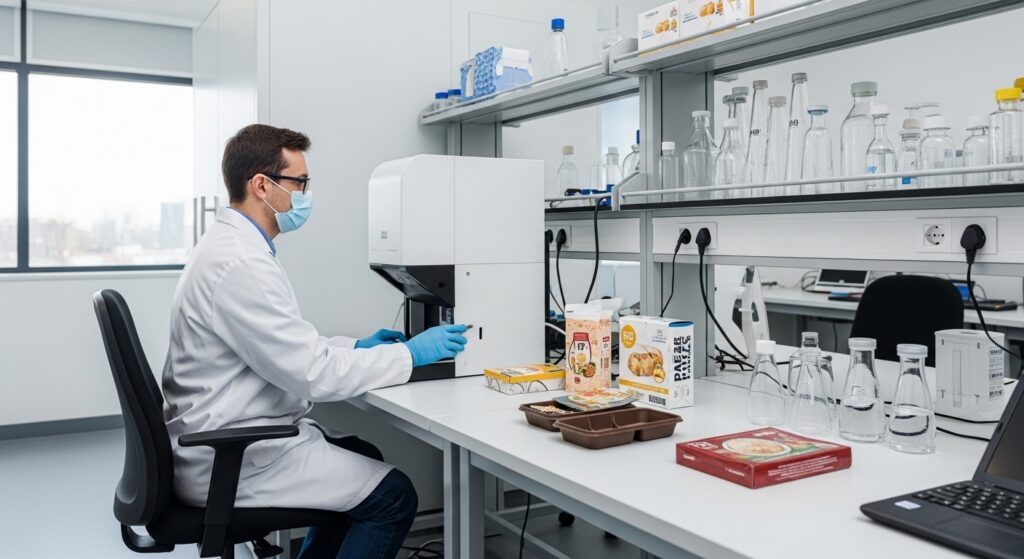
In the high-stakes world of food and beverage manufacturing, the container is as critical as the contents. However, as 2026 represents a regulatory “cliff” that is looming for packaging engineers and regulatory affairs managers.
New, stringent bans on per- and polyfluoroalkyl substances (PFAS)—often called “forever chemicals”—are set to take effect in major markets, including California, Minnesota, and Maine. If your company hasn’t yet validated its supply chain through rigorous PFAS packaging testing, you could be facing more than just a logistical headache; you could be facing significant legal penalties and brand damage.
Why 2026 is the Year of PFAS Enforcement
While federal oversight from the EPA continues to evolve, individual states are charging ahead with zero-tolerance policies for “intentionally added” PFAS in food contact materials.
Key State Deadlines to Watch:
- California: Building on existing bans for plant-based packaging, California’s latest regulations accelerate the phase-out of PFAS across broader consumer product categories.
- Minnesota: UnderAmara’s Law, manufacturers must report any intentionally added PFAS to the Minnesota Pollution Control Agency by July 1, 2026, with a total ban on non-essential uses quickly following.
- Maine: Widely considered the most expansive law in the U.S., Maine prohibits the sale of many product categories containing PFAS starting January 1, 2026.
The primary challenge? PFAS are prized for their grease, water, and heat resistance. They are ubiquitous in pizza boxes, microwave popcorn bags, and eco-friendly molded fiber bowls. Transitioning away from these chemicals is not as simple as a “find and replace” in your spec sheets.
The Hidden Risks in “Eco-Friendly” Packaging
Many manufacturers are inadvertently introducing PFAS while trying to improve their sustainability profile. Bronte Ushaglan, Food Scientist and President of United Food Labs, warns that the most dangerous assumption a company can make is that “plant-based” equals “PFAS-free.”
When asked about accidental introduction, Ushaglan noted:

“A common scenario is when a company switches to grease-resistant or moisture-barrier packaging—such as paper wraps, molded fiber, or coated cartons. Assuming it’s safe because it’s plant-based or marketed as eco-friendly. Because PFAS are often added at very low levels and aren’t always disclosed on spec sheets, the manufacturer may never test the finished packaging as it’s not required. This is why supplier documentation alone isn’t enough and why packaging-specific PFAS testing is critical before making PFAS-free claims.”
Technical Validation: Organic Fluorine vs. Targeted Testing
When it comes to food contact material testing, not all methods are created equal. Because there are over 10,000 individual PFAS compounds, testing for each one individually (targeted testing) is virtually impossible.
Instead, regulatory bodies are increasingly turning to the organic fluorine test.
| Testing Method | Best Used For | Regulatory Standing |
| Targeted PFAS Screen | Identifying specific known compounds (PFOA/PFOS). | Necessary for specific EPA compliance but limited in scope. |
| Total Organic Fluorine (TOF) | Screening for “intentionally added” PFAS at the molecular level. | The gold standard for state-level “Forever Chemical” bans. |
Why Third-Party Lab Testing is Your Best Defense
Relying on a “Certificate of Compliance” from a supplier is no longer enough to satisfy state regulators or vigilant consumer advocacy groups. Bronte Ushaglan (United Food Labs) highlights the primary pitfall in this approach:
“The most common mistake is relying solely on supplier statements or generic claims instead of verifying actual chemical content through third-party testing and documentation.”
The Value of the Contract Laboratory Marketplace
- Impartiality: Third-party labs provide an unbiased “Pass/Fail” report that holds up during regulatory audits and prevents potential litigation.
- Specialized Equipment: PFAS testing requires highly sensitive instruments like LC-MS/MS and Combustion Ion Chromatography to detect chemicals at the parts-per-billion level.
- Liability Mitigation: Documenting your due diligence through an independent lab protects your brand from the “forever chemical” liability currently sweeping the industry.
Final Checklist: Is Your Supply Chain Ready?
- [ ] Inventory Audit: Identify every food contact material in your portfolio.
- [ ] Supplier Inquiry: Request full chemical disclosures, but treat them as a starting point.
- [ ] Independent Testing: Schedule Organic Fluorine testing for all grease-resistant or moisture-barrier components.
- [ ] Documentation: Maintain a robust record of test results to prepare for the July 2026 reporting deadlines.
The clock is ticking toward 2026. Verifying your materials today ensures that your brand remains on the shelves tomorrow.
Does your packaging meet the 2026 state requirements? Visit Contract Laboratory to find a qualified laboratory, or Submit a Testing Request to get competitive quotes for your PFAS Packaging Testing needs today.