

Integrating sustainability into laboratory testing protocols has evolved from a niche preference to a critical industry mandate. This shift is driven by both environmental concerns and economic efficiency. Laboratories are resource-intensive environments, often consuming significantly more energy and water than typical commercial spaces. Consequently, they face increasing pressure to adopt green practices while maintaining rigorous scientific standards. This transition is not merely ethical; it is becoming regulatory. Adhering to emerging standards ensures long-term operational viability and cost reduction. By examining regulatory compliance, equipment certification, and process optimization, laboratory managers can prioritize stewardship without compromising precision.
Navigating Standards for Sustainability in Laboratory Testing
The framework for sustainability in laboratory testing is built upon a complex matrix of international standards, voluntary certifications, and emerging government regulations. Unlike general office environments, laboratories present unique challenges regarding hazardous waste, high-energy ventilation, and single-use plastics. Consequently, generic environmental standards often require adaptation to fit the specific needs of clinical, research, and industrial testing facilities.
ISO 14001 and Laboratory Specifics
ISO 14001 remains the gold standard for Environmental Management Systems (EMS). While it provides a high-level framework for organizations to manage environmental responsibilities, its application in a laboratory setting requires specific interpretation. For laboratory testing facilities, ISO 14001 compliance involves rigorous lifecycle analysis of reagents, risk management regarding chemical disposal, and the establishment of measurable targets for carbon footprint reduction. Certification bodies now increasingly look for evidence that laboratories are not just managing waste, but actively reducing the resource intensity of their testing methodologies.
The My Green Lab Certification and ACT Label
Specific to the scientific community, the My Green Lab certification has emerged as a premier benchmark for sustainability. This program assesses laboratories across various categories, including cold storage, plug load, and water usage. A critical component of this ecosystem is the ACT (Accountability, Consistency, and Transparency) label. Functioning similarly to a nutrition label for laboratory products, the ACT label provides transparency regarding environmental impact data across manufacturing, use, and disposal stages.
Prioritizing equipment and consumables that carry the ACT label allows procurement departments to make data-driven decisions that directly support sustainability goals. This transparency forces manufacturers to optimize their supply chains, creating a positive feedback loop that benefits the entire industry.
The Laboratory Efficiency Assessment Framework (LEAF)
Developed by University College London, LEAF has gained international traction as a standard for sustainable laboratory operations. It offers a tiered certification system (Bronze, Silver, and Gold) that guides users through criteria such as:
- Sample management and storage optimization.
- Ventilation management.
- Procurement and waste reduction.
- Research quality and integrity.
Adopting LEAF standards helps institutions quantify their carbon savings, providing the metrics necessary to justify investments in greener technologies for laboratory testing.
Waste Management Protocols in Sustainable Laboratory Testing
Waste generation represents one of the most visible hurdles to achieving sustainability in laboratory testing. The historical reliance on single-use plastics—pipette tips, petri dishes, and flasks—has created a significant waste stream that is often difficult to recycle due to biological or chemical contamination. Modern sustainable protocols necessitate a shift from disposal to diversion and reduction.
The Hierarchy of Laboratory Waste
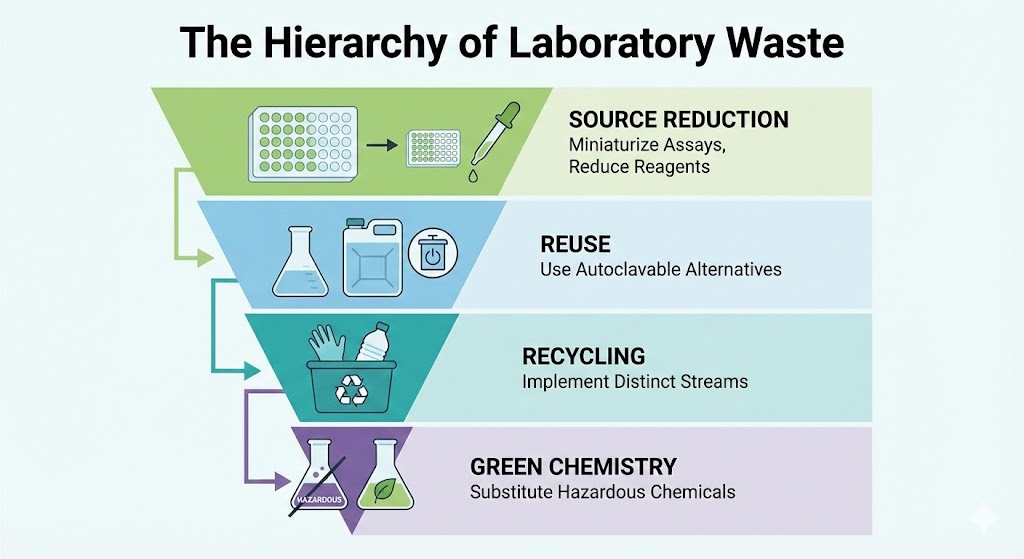
Effective waste management in laboratory testing follows an inverted pyramid hierarchy, prioritizing source reduction over treatment.
- Source Reduction: This involves miniaturizing assays to require smaller volumes of reagents and plasticware. Moving from 96-well plates to 384-well plates, for example, maintains throughput while halving material usage.
- Reuse: Where sterility requirements permit, replacing single-use plastics with autoclavable glass or robust plastic alternatives significantly reduces landfill contributions.
- Recycling: Implementing distinct recycling streams for non-hazardous packaging (cardboard, uncontaminated plastics) is a baseline requirement. Specialized recycling programs for nitrile gloves and specific lab plastics are becoming more accessible.
- Green Chemistry: Substituting hazardous chemicals with less toxic alternatives reduces the complexity and cost of hazardous waste disposal.
Green Chemistry and Solvent Recovery
The principles of Green Chemistry are integral to sustainability in laboratory testing. By designing chemical products and processes that reduce or eliminate the use or generation of hazardous substances, laboratories protect both human health and the environment.
Looking to get laboratory waste testing for hazardous chemicals?
Submit a quick lab request or find expert lab partners near you.
A practical application of this is solvent recovery. High-Performance Liquid Chromatography (HPLC) and other analytical techniques generate vast quantities of solvent waste. Installing solvent recycling systems allows laboratories to distill and reuse solvents like acetone, xylene, and ethanol. This not only diminishes the volume of hazardous waste requiring transport and incineration but also drastically cuts procurement costs.
Table 1: Impact of Green Chemistry Implementation
| Traditional Method | Sustainable Alternative | Environmental Benefit |
|---|---|---|
| Ethidium Bromide for gel staining | SYBR Safe or similar non-toxic stains | Reduces mutagenic waste; simplifies disposal compliance. |
| Mercury thermometers | Alcohol or digital thermometers | Eliminates toxicity risk; removes hazardous cleanup protocols. |
| Chronic use of fresh solvents | In-house solvent distillation/recycling | Reduces procurement by up to 80%; minimizes hazardous waste streams. |
| Water-aspirated vacuum filtration | Diaphragm vacuum pumps | Saves ~50,000 gallons of water per year per unit; eliminates contamination. |
Optimizing Energy Efficiency in Laboratory Testing Facilities
Laboratories are energy-intensive, often consuming five to ten times more energy per square foot than standard office buildings. The primary drivers of this consumption are heating, ventilation, and air conditioning (HVAC) systems required to maintain air quality, alongside high-powered analytical instrumentation and cold storage. Addressing these areas is fundamental to improving sustainability in laboratory testing.
Ventilation and Fume Hood Management
The chemical fume hood is frequently the single largest energy consumer in a laboratory due to the immense volume of conditioned air it exhausts. A single fume hood running 24/7 can consume as much energy as three residential homes.
- Variable Air Volume (VAV) Systems: Modernizing facilities with VAV hoods, which reduce airflow when the sash is closed, creates immediate energy savings.
- “Shut the Sash” Programs: Behavioral changes are as critical as hardware. Implementing sensors and alarms that remind operators to lower the sash when the hood is not in active use significantly reduces the load on the HVAC system.
- Air Change Rates: Re-evaluating Air Changes per Hour (ACH) based on real-time air quality monitoring rather than static, maximum-capacity defaults can lead to substantial reductions in fan energy and thermal conditioning requirements.
Cold Storage Management
Ultra-Low Temperature (ULT) freezers are ubiquitous in laboratory testing, particularly in life sciences. A standard -80°C freezer consumes approximately the same amount of energy as a detached house.
- High-Efficiency Models: Upgrading to Energy Star-certified ULT freezers can reduce energy consumption by 30-50%.
- Temperature Tuning (-70°C Initiative): Initiatives like the International Laboratory Freezer Challenge have popularized the shift to -70°C. Evidence suggests that for many sample types (e.g., DNA, RNA, proteins), storage at -70°C is as effective as -80°C. Raising the temperature by these 10 degrees can reduce energy consumption by up to 30% and prolong the compressor’s lifespan.
- Inventory Management: Regular defrosting and organized inventory systems prevent “door-open” time, minimizing temperature fluctuations and energy spikes.
Water Conservation Strategies for Laboratory Testing Operations
Water is a finite resource often overlooked in the discussion of sustainability in laboratory testing. From cooling loops to autoclave cycles and purification systems, laboratories require high volumes of water, much of which is treated to high purity levels before use, increasing its embedded energy cost.
Closed-Loop Cooling Systems
Many older instruments rely on single-pass cooling, where tap water flows through the equipment once to absorb heat and is then discharged directly down the drain. This practice is highly wasteful. Retrofitting equipment with closed-loop chillers or recirculating water baths eliminates continuous water consumption, protecting the laboratory from fluctuations in municipal water supply and reducing operating costs.
Water Purification Optimization
Reverse Osmosis (RO) and Deionized (DI) water systems are essential for analytical laboratory testing, yet they generate significant wastewater (brine). High-efficiency purification units now exist that improve the product-to-waste ratio. Furthermore, laboratories must assess the water quality grade required for specific tasks; using Type I ultrapure water for tasks that only require Type II or Type III water wastes energy and shortens the lifespan of purification cartridges.
Autoclave Efficiency
Steam sterilization is water and energy-intensive. To enhance sustainability, facility managers should ensure autoclaves are fitted with water-saving devices that recirculate cooling water. Operational protocols should mandate that autoclaves are only run when full to maximize efficiency per cycle, rather than running multiple partial loads.
The Future of Compliance and Sustainability in Laboratory Testing
The trajectory of the industry indicates that sustainability in laboratory testing will transition from a voluntary best practice to a mandatory requirement for funding and licensure. Granting bodies and regulatory agencies are increasingly incorporating environmental criteria into their evaluation processes.
Funding and Grant Requirements
Some funding bodies are increasingly incorporating sustainability considerations into their evaluation processes. While not yet universal, agencies like UK Research and Innovation (UKRI) have made significant strides in this direction, and discussions within the National Institutes of Health (NIH) suggest a similar trajectory. Laboratories that have already established robust sustainable frameworks will have a competitive advantage in securing funding. This trend aligns financial incentives with environmental performance, ensuring that sustainability becomes central to the business model of scientific inquiry.
Data-Driven Sustainability
The future of compliance lies in data. Smart building technologies and IoT (Internet of Things) sensors will allow laboratory testing facilities to monitor energy and water usage in real-time. This granular data will facilitate precise reporting for Environmental, Social, and Governance (ESG) criteria, which investors and stakeholders increasingly demand. Automated systems will adjust ventilation, lighting, and equipment power states based on occupancy and usage patterns, removing the reliance on manual intervention.
Supply Chain Influence (Scope 3 Emissions)
Laboratories possess significant purchasing power. By mandating that vendors provide sustainable packaging, take-back programs, and ACT-labeled products, laboratory testing facilities can drive systemic change throughout the supply chain. This collective action is crucial for addressing Scope 3 emissions—indirect emissions that occur in the value chain—which often constitute the majority of a scientific organization’s carbon footprint.
Advancing Sustainability in Laboratory Testing
The integration of sustainability into laboratory testing environments represents a maturation of the scientific industry. By adhering to rigorous standards like ISO 14001 and adopting certifications such as LEAF and My Green Lab, laboratories demonstrate that environmental responsibility and scientific excellence are mutually reinforcing.
Through strategic management of waste, energy, and water, facilities can achieve significant cost savings, ensure regulatory compliance, and safeguard their reputation in an eco-conscious market. As the global regulatory landscape tightens, the laboratories that proactively embrace these sustainable methodologies will define the future of scientific best practices.
Submit a testing request today!
This article was created with the assistance of Generative AI and has undergone editorial review before publishing.