
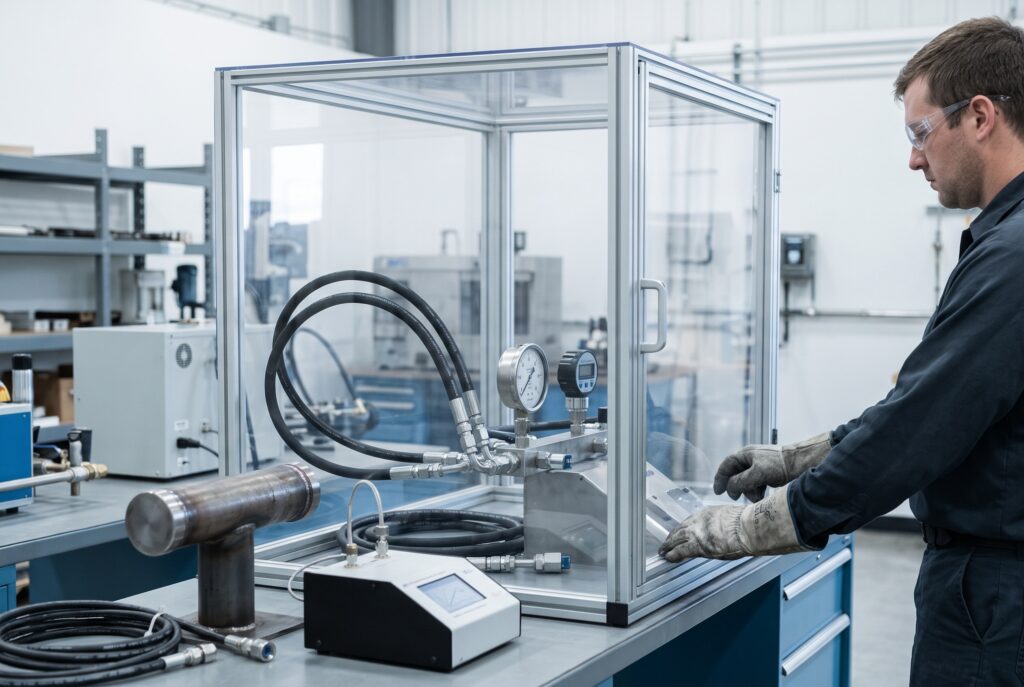
Ice is roughly 9% less dense than liquid water, according to the US Geological Survey, so water takes up more room as it freezes. Inside a sealed pipe or a water-filled line left in an unheated building, that extra volume has nowhere to go.
Hoses face a different winter problem. Rubber and plastic stiffen as temperatures fall; the ISO maintains a dedicated test method for measuring how hoses bend at sub-ambient temperatures. Pressure and leak testing finds those weak points before service does, and the labs that run it carry the burden of proof. A pass or fail result holds up only if the test medium, pressure, hold time, and instrument accuracy match what the governing standard requires. And these requirements start with one basic distinction.
Key Takeaways
- Hydrostatic testing pressurizes a part with liquid; pressure decay testing pressurizes it with gas and tracks the pressure drop over time.
- ASTM E432 notes that dynamic leak test methods run faster but with lower sensitivity than static methods, and that test-system sensitivity differs from instrument sensitivity.
- ASTM E1003 limits hydrostatic leak testing to leakage of 1 × 10⁻⁴ std cm³/s or larger and excludes components meant to hold toxic or explosive gas.
- ASTM published E2930-26 in July 2026. The practice calculates leakage from pressure, temperature, and time, and it does not apply to deformable vessels.
- ISO 1402:2021 and SAE J343 cover hydrostatic and performance testing of hose assemblies; ISO 10619-2:2021 covers hose flexibility and stiffness at sub-ambient temperatures.
- Under 49 CFR 180.205, cylinder requalifiers need a DOT approval and must verify daily that their pressure-indicating device reads within ±1.0% of the prescribed test pressure.
- ISO/IEC 17025 accreditation covers a listed scope of methods, so hydrostatic and pressure decay capability each need to appear on a lab’s scope.
What Is Pressure and Leak Testing?
Pressure and leak testing covers two related questions: A pressure test asks whether a part holds a specified pressure without rupture or unacceptable deformation. A leak test asks whether fluid escapes, where, and how fast. Many programs answer both in one setup, but the acceptance criteria differ.
Regulatory definitions draw the same line. US DOT rules for cylinder requalification define a proof pressure test as a liquid-based pressure test by interior pressurization without measuring the cylinder’s expansion. A volumetric expansion test, by contrast, measures how much the cylinder grows under pressure and how much of that growth remains after release.
Leak tests divide further. ASTM E432, the guide for selecting a leak testing method, separates leak measurement from leak location. It also distinguishes dynamic methods, which run faster but are less sensitive, from static methods. The ASTM frames method selection as a balance of sensitivity, cost, and reliability. It adds that the sensitivity of the full test system differs from the sensitivity of the instrument alone.
| Approach | Test medium | What it shows | Common standards |
|---|---|---|---|
| Hydrostatic leak or proof test | Liquid, usually water | Visible leakage, rupture, or permanent deformation at pressure | ASTM E1003, ISO 1402, SAE J343 |
| Pressure decay leak test | Gas, usually air | Leakage rate calculated from pressure loss over time | ASTM E2930-26 |
| Volumetric expansion test | Liquid | Total and permanent expansion of a cylinder | 49 CFR 180.205 |
| Low-temperature flexibility test | Cold chamber, no internal pressure | Stiffness or flexibility of hose bent at sub-ambient temperature | ISO 10619-2 |
Which Standards Govern Hydrostatic and Leak Testing?
No single standard covers every pressurized part. Specifications usually pair a general leak testing practice with a product standard for the component in question. The table summarizes the documents most often named for hoses, piping, and sealed rigid parts.
| Standard | Scope | Notable limits | Current edition |
|---|---|---|---|
| ASTM E432 | Guide for selecting a leak testing method for leak measurement or location | Guidance only; no acceptance criteria | E432-91(2022) |
| ASTM E1003 | Hydrostatic leak testing of piping, valves, and containers pressurized with a liquid | Leakage of 1 × 10⁻⁴ std cm³/s or larger; not for toxic or explosive gas service | E1003-13(2022) |
| ASTM E2930 | Pressure decay leak testing of vessels under positive pressure | Not for deformable vessels | E2930-26 (July 2026) |
| ISO 1402 | Hydrostatic testing of rubber and plastics hoses and hose assemblies, including dimensional stability | Hose and hose assemblies only | ISO 1402:2021, reviewed 2026 |
| SAE J343 | Test procedures for SAE 100R series hydraulic hose and assemblies | Performance criteria sit in SAE J517 | J343_202310 (reaffirmed October 2023) |
| ISO 10619-2 | Hose and tubing flexibility and stiffness at sub-ambient temperatures | Three methods split by bore size | ISO 10619-2:2021 |
| 49 CFR 180.205 | Requalification of DOT specification cylinders | Applies to cylinders in hazardous materials transport | Current eCFR |
ASTM Committee E07 on Nondestructive Testing maintains E432, E1003, and E2930. ISO 1402 and ISO 10619-2 come from ISO/TC 45/SC 1, the subcommittee for rubber and plastics hoses and hose assemblies.
How Does Pressure Decay Testing Work under ASTM E2930-26?
Pressure decay testing pressurizes a sealed part with gas, isolates it from the supply, and tracks how far the pressure falls over a set time. Any drop beyond what temperature change explains points to leakage. Because the part stays dry, the method avoids the drying step that liquid testing can require.
ASTM published E2930-26 in July 2026, replacing E2930-13(2021). The practice calculates the leakage rate, expressed as mass loss, from measured pressure, temperature, and time using the ideal gas law. It applies only to rigid vessels. A deformable part changes volume as pressure changes, and a rigid-vessel calculation reads that change as leakage.
From Pressure Drop to Leak Rate
The arithmetic behind the method is straightforward. A Los Alamos National Laboratory engineering standard for positive pressure decay testing expresses the leak rate as test system volume multiplied by pressure change, divided by time. Its worked example uses a 20 cu. inch volume, a 0.5 psi allowable drop, and a leak rate limit of 1 × 10⁻³ atm·mL/s. That combination yields a minimum test time of about 5.3 minutes, which the example doubles to 10.6 minutes for added confidence.
The example shows why volume matters. A larger internal volume dilutes the pressure signal from a given leak, so detecting the same leak takes longer or needs a more sensitive transducer.
Measurement Requirements for Labs
ASTM’s significance and use summary for E2930-26 states that total pressure change during a test should stay under 10% of the starting pressure. The 2013 edition’s published text adds that when a test certifies a maximum leakage rate, the equipment and test duration should deliver resolution ten times finer and accuracy four times finer than the specified limit. The standard also places test pressure in the specification: Leak test specifications should name the vessel test pressure or differential pressure, and tests without one should use a safe pressure consistent with applicable safety standards.
How Are Hydraulic Hoses Tested for Pressure and Cold Performance?
Hoses sit outside the scope of ASTM E2930. They flex, stretch, and swell under pressure, which is exactly the behavior the pressure decay practice excludes. Hose testing programs, therefore, rely on hydrostatic methods and hose-specific standards.
ISO 1402:2021 specifies hydrostatic test methods for rubber and plastic hoses and hose assemblies, including the measurement of dimensional stability. Dimensional stability describes how much a hose changes in length and diameter under pressure. For hydraulic hose built to SAE specifications, SAE J343 sets test procedures for SAE 100R series hose and hose assemblies with attached end fittings. The pass and fail criteria sit in the individual hose specifications of SAE J517.
Low-Temperature Flexibility
Cold adds a separate question. Rubber and plastic hose grows stiffer as temperature falls, so a hose that passes a room-temperature pressure test may still bend differently in winter service. ISO 10619-2:2021 addresses this with three bending tests at sub-ambient temperatures, each matched to bore size:
- Method A measures the stiffness of noncollapsible hose and tubing with a bore up to 25 mm as temperature drops from standard laboratory conditions.
- Method B assesses flexibility by bending hose with a bore up to 100 mm around a mandrel at a specified sub-ambient temperature. ISO notes it can also serve as a routine quality control test.
- Method C measures stiffness of noncollapsible hose and tubing with a bore of 100 mm or greater.
Freeze Crack Corrode article covers broader cold-weather materials testing, and the Polymers, Plastics & Rubber product category lists related providers.
How Are Pipe Weldments, Vessels, and Cylinders Tested?
Rigid parts open up both test families. A welded pipe spool, a manifold, or a small sealed housing can undergo hydrostatic testing, pressure decay testing, or both.
Hydrostatic Testing of Rigid Parts
ASTM E1003 covers hydrostatic leak testing of welded or fitted sections that analysts can seal at the ends and that are designed for internal pressure. ASTM lists quality control and field inspection of piping, pipelines, valves, and liquid containers as typical uses. The practice detects leakage of 4.5 × 10⁻⁹ mol/s (1 × 10⁻⁴ std cm³/s) or larger. ASTM states that this sensitivity falls short for components expected to contain toxic or explosive gas under pressure, which calls for more sensitive methods.
Pressure Decay Testing of Rigid Parts
Rigid weldments and housings meet E2930’s core assumption: their volume stays essentially constant under test pressure. That makes pressure decay a fit for production screening of welded assemblies, provided the specification names the test pressure, the allowable leak rate, and the test duration.
What DOT Rules Require of Cylinder Requalifiers
Cylinder requalification shows how far regulation can reach into a lab’s daily routine. Under 49 CFR 180.205, only a person holding a current DOT approval may represent that a specification cylinder has been requalified, and requalifiers must keep the records that §180.215 prescribes at each test location. The regulation then sets specific equipment and procedure requirements:
- Test method: Unless otherwise provided, retesting must measure the cylinder’s expansion under pressure and follow CGA C-1.
- Visual inspection: Each pressure test comes with an internal and external visual inspection under the applicable CGA pamphlet.
- Daily verification: Before each day’s retesting, the requalifier must confirm with a calibrated cylinder that the pressure-indicating device reads within ±1.0% of the prescribed test pressure.
- Gauge accuracy: The pressure-indicating device itself must be certified to ±0.5% or better of its full range and must read from 90% to 110% of the minimum prescribed test pressure.
- Retests: A system check may run at or below 90% of test pressure, and an equipment malfunction or operator error permits a repeat test under CGA C-1. That allowance does not extend to a cylinder that requires condemnation.
- Condemnation: For most DOT specification cylinders, permanent expansion above 10% of total expansion requires condemnation; the limit for DOT 4E aluminum cylinders is 12%. The requalifier must mark the cylinder and notify the owner in writing.
A PHMSA interpretation letter applies these provisions to retests interrupted by equipment failure. Our ASME Standards Testing article covers related pressure equipment codes.
What Do Pressure and Leak Testing Requests Ask of Labs?
The standards above leave several decisions to the specification rather than the lab. When those decisions reach the lab already made, quoting and scheduling move quickly. Otherwise, the lab has to resolve them with the client before a test can mean anything. A complete request typically fixes six parameters:
- Test medium: liquid for hydrostatic testing, or gas for pressure decay.
- Test pressure and hold time: E2930 expects the specification to name the test or differential pressure.
- Acceptance criterion: an allowable leak rate, no visible leakage, or a maximum permanent deformation.
- Governing standard and edition: for example, E2930-26 rather than the superseded E2930-13(2021).
- Conditioning: temperature conditioning, such as the sub-ambient bend tests in ISO 10619-2.
- Sample count: the number of parts, plus any sampling plan.
Accreditation Scope
Some purchasers specify testing under ISO/IEC 17025:2017, which sets requirements for the competence, impartiality, and consistent operation of testing laboratories. Accreditation applies to a listed scope of methods. A lab accredited for hydrostatic testing to ISO 1402 does not automatically hold accreditation for pressure decay testing to E2930, and a scope that names a superseded edition may not satisfy a request that cites E2930-26. Contract Laboratory’s ISO 17025 accredited laboratories article explains the framework in more detail.
Where Pressure Testing Meets Failure Analysis
A leak or burst often turns a routine test into an investigation. Labs that pair pressure testing with fractography and metallography can follow a failed part from first leak to root cause. This failure analysis testing guide covers the methods and standards behind them.
Connect on Contract Laboratory
Contract Laboratory connects laboratories and CROs that perform hydrostatic, pressure decay, burst, and leak testing with manufacturers and engineers who need that work done.
- Register Your Lab to receive matched pressure and leak testing requests in your areas of capability.
- View Requests to see open projects, including hydrostatic and pressure decay work.
- Submit a Request to find a lab for a part, a test standard, or a pressure test program.
This article was created with the assistance of Generative AI and has undergone editorial review before publishing.
Sources and Further Reading
- ASTM International. E432-91(2022), Standard Guide for Selection of a Leak Testing Method. Abstract page only.
- ASTM International. E1003, Standard Practice for Hydrostatic Leak Testing. Scope page only.
- ASTM International. E2930-26, Standard Practice for Pressure Decay Leak Test Method, ASTM store and ANSI Webstore listing. Scope and significance pages only.
- ASTM International. E2930-13(2021), catalog listing with significance text. Superseded edition; secondary catalog.
- ISO. ISO 1402:2021, Rubber and Plastics Hoses and Hose Assemblies, Hydrostatic Testing (national standards body record). Scope page only.
- ISO. ISO 10619-2:2021, Rubber and Plastics Hoses and Tubing, Bending Tests at Sub-Ambient Temperatures. Abstract page only.
- ISO. ISO/IEC 17025:2017, General Requirements for the Competence of Testing and Calibration Laboratories.
- SAE International. J343_202310, Test and Test Procedures for SAE 100R Series Hydraulic Hose and Hose Assemblies. Scope page only.
- US Government Publishing Office. 49 CFR 180.203 and 180.205, 2023 edition, and current eCFR Part 180.
- Pipeline and Hazardous Materials Safety Administration. Interpretation on cylinder requalification under 49 CFR 180.205.
- Los Alamos National Laboratory. Engineering Standards Manual, ITM-1306-NDE-LT-201, Positive Pressure Decay Method, Attachment 1. Full text reviewed.
- US Geological Survey. Water Science School: Water Density. Archived copy.
- Contract Laboratory. Hydrostatic Pressure Testing of Hydraulic Hose Assemblies and Pressure Decay Leak Testing of Pipe Weldment at 60 PSI (lab requests).
Frequently Asked Questions (FAQs)
Hydrostatic testing pressurizes a part with liquid, usually water, and checks for leakage, rupture, or deformation. Pressure decay testing pressurizes a rigid part with gas and calculates leakage from the pressure drop over time, as described in ASTM E2930-26.
ASTM E2930 does not apply to deformable vessels. Hoses change volume under pressure, so hose programs typically use hydrostatic methods, such as those mentioned in ISO 1402:2021 and SAE J343.
ASTM E1003 limits its procedures to leakage of 1 × 10⁻⁴ std cm³/s or larger. ASTM states that this sensitivity is insufficient for components meant to contain toxic or explosive gas under pressure.
ASTM published E2930-26 in July 2026. The publicly available summary retains the rigid-vessel scope and the guidance to keep total pressure change under 10% of the starting pressure. ASTM’s summary does not list specific clause changes, so a detailed comparison requires the full standard.
ISO 10619-2:2021 specifies three bending tests at sub-ambient temperatures. Method A and Method C measure stiffness, and Method B assesses flexibility by bending hose around a mandrel. The method depends on bore size.
Under 49 CFR 180.205(g), the pressure-indicating device must be certified to ±0.5% or better of its full range, and the requalifier must confirm each test day that the test system reads within ±1.0% of the prescribed test pressure.
For most DOT specification cylinders, 49 CFR 180.205(i) requires condemnation when permanent expansion exceeds 10% of total expansion. The limit for DOT 4E aluminum cylinders is 12%.
Not automatically. ISO/IEC 17025:2017 accreditation covers a listed scope of methods, so each method and standard, such as ASTM E1003 or E2930, needs to appear on the scope.
The published significance text for E2930-13(2021) states that, when certifying a maximum leakage rate, equipment and test duration should give resolution ten times finer and accuracy four times finer than the specified limit. Labs working to E2930-26 can confirm the current wording in the full standard.