
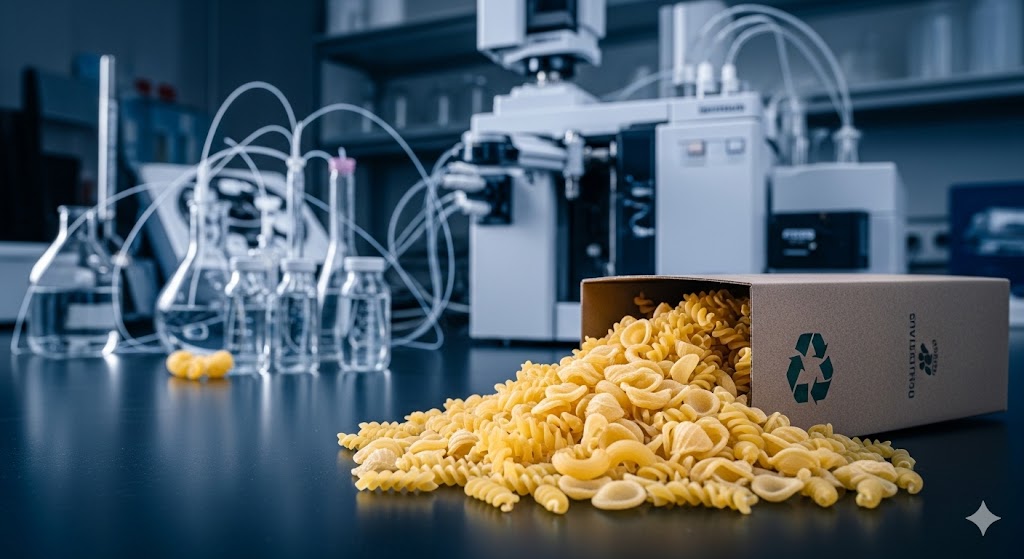
Sustainability initiatives have driven a massive shift toward recycled paper and cardboard in food packaging. While excellent for the environment, this shift has inadvertently introduced a complex chemical hazard into the global food supply chain: Mineral Oil Hydrocarbons (MOH).
Specifically categorized as MOSH (Mineral Oil Saturated Hydrocarbons) and MOAH (Mineral Oil Aromatic Hydrocarbons), these chemical compounds originate from the inks and adhesives used in recycled newsprint and magazines. For brands exporting dry goods like pasta, rice, and cereals to the European Union—where regulations on these contaminants are increasingly strict—proactive MOSH/MOAH migration testing is no longer just a quality assurance measure; it is a critical requirement for market access.
The Vapor Phase: How Food Packaging Migration Occurs
The most dangerous misconception regarding packaging safety is the belief that physical separation prevents contamination. Many brands assume that if their dry pasta is sealed in a standard inner plastic bag and then placed in a recycled cardboard carton, the food is protected.
Bronte Ushaglyan, Food Scientist and President of United Food Labs, explains why this assumption is structurally flawed:

“Mineral oils in packaging, like recycled cardboard or printed paper, can slowly migrate into food, especially fatty items like chocolate, nuts, or baked goods. The oils are often in inks or recycled fibers and move through the packaging over time, not instantly. Factors like temperature, storage duration, and fat content influence how much migrates. For example, chocolate wrapped in recycled cardboard may absorb mineral oils gradually during weeks of storage.”
Because dry foods have a large surface area and are often stored for long periods, they act like chemical sponges, readily absorbing these migrating mineral oils.
The EU Regulatory Landscape and MOAH Toxicity
While both compounds are monitored, MOAH is of particular concern to European regulators. The European Food Safety Authority (EFSA) considers MOAH to contain potential genotoxic carcinogens. Consequently, several European countries, notably Germany and France, have established strict, aggressively enforced limits on mineral oil hydrocarbons in food and packaging.
If a shipment arrives at an EU port and customs officials detect MOAH above the allowable thresholds, the entire container can be rejected or destroyed. Relying on outdated packaging specifications without executing current MOSH MOAH testing is a high-stakes gamble for any global exporter.
Technical Validation: The Analytical Challenge of MOSH/MOAH
Testing for these compounds is notoriously difficult due to two primary confounding factors. First, mineral oils are ubiquitous in manufacturing environments; everything from hydraulic fluids and conveyor belt lubricants to release agents can inadvertently contaminate a sample before it even reaches the lab, making it hard to isolate packaging migration as the true root cause. Second, many foods contain naturally occurring biogenic hydrocarbons—such as the natural waxes found on the skins of fruits, in plant oils, or within the bran of certain grains. Under standard analysis, these natural waxes look chemically identical to synthetic mineral oils, creating severe false positives if the laboratory does not employ advanced sample clean-up procedures (like epoxidation) to separate them.
Ushaglyan highlights the complexity of accurate food packaging migration analysis:
“Recycled cardboard can be risky for food safety because it may carry microbes, chemicals, or residues from previous use. Contaminants like bacteria, mold, inks, or adhesives can transfer to food, especially if packaging isn’t properly treated or lined. While it’s eco-friendly, using recycled cardboard for direct food contact often requires barriers, coatings, or strict sourcing controls to prevent contamination and meet safety regulations. Without these, it’s safer for secondary packaging only.”
| Analytical Method | Application | Critical Insight |
|---|---|---|
| Online LC-GC-FID | Standard Quantification | The industry gold standard. Combines Liquid Chromatography (to separate MOSH from MOAH) with Gas Chromatography for precise measurement. |
| GCxGC-TOF-MS | Advanced Confirmation | Used to confirm the specific source of the mineral oil when LC-GC-FID results are ambiguous or highly complex. |
| Barrier Testing | Packaging Efficacy | Tests the functional barrier (e.g., specific inner liners or coatings) to ensure it successfully blocks vapor-phase migration over the product’s shelf life. |
Why Third-Party Testing is Critical for Global Exporters
Internal visual inspections and generic supplier guarantees (“food grade cardboard”) are insufficient defenses against EU regulatory audits.
The Value of Independent Verification:
- Functional Barrier Validation: A third-party lab can conduct accelerated shelf-life testing to prove that your specific inner liner (like PET, aluminum foil, or specialized coatings) actually blocks MOSH/MOAH migration from your recycled outer carton.
- Source Identification: If contamination is found, an independent lab can help you determine if the MOSH/MOAH came from the recycled cardboard, the printing inks, or the lubricating oils on your factory’s conveyor belts.
- Export Security: An accredited Certificate of Analysis (COA) demonstrating compliance with EFSA and specific member-state guidelines ensures smooth customs clearance and protects retailer relationships.
Final Checklist: Is Your Packaging EU-Compliant?
- [ ] Packaging Audit: Are you using recycled cardboard for primary or secondary packaging of dry goods?
- [ ] Barrier Efficacy: Has your inner bag or liner been scientifically validated to block mineral oil vapor migration?
- [ ] Baseline Testing: Have you conducted baseline MOSH MOAH testing on both your empty packaging and your finished, shelf-stored food?
- [ ] Supply Chain Transparency: Do you require your packaging suppliers to provide mineral oil migration data for their inks and adhesives?
Don’t let your commitment to sustainable packaging compromise your food safety or your export strategy.
Do you need to validate your packaging barriers or test your food for mineral oil migration? Visit Contract Laboratory to find a qualified laboratory, or Submit a Testing Request to get competitive quotes for your MOSH/MOAH migration testing needs today.