
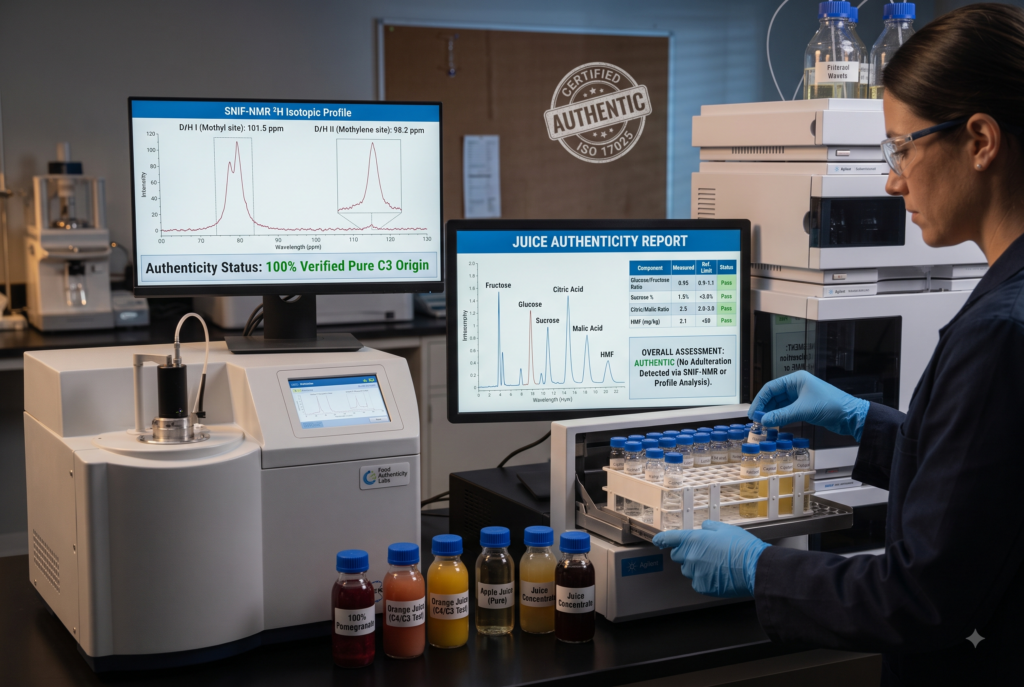
Premium not-from-concentrate (NFC) juices command high retail prices, making them a primary target for economically motivated adulteration (EMA). When dealing with high-value commodities like 100% pomegranate, apple, or pure citrus juice, suppliers have a strong financial incentive to stretch the product. Because fruit juice matrices are chemically complex, adulterants can easily bypass standard Brix value (total soluble solids) and titratable acidity measurements using targeted additives.
Proving juice authenticity goes beyond basic quality control. Beverage brands need concrete data to meet strict retailer compliance requirements and keep fraudulent raw materials out of their production lines.
Common Forms of Fruit Juice Adulteration
Juice fraud generally falls into four categories, each aimed at increasing volume or mimicking a premium profile while cutting costs:
- Undeclared Sugar Addition: Stretching the yield with cheaper exogenous sugars. While high-fructose corn syrup (HFCS) and cane sugar are standard tools, advanced adulteration uses beet sugar or invert syrups calibrated to match the natural sugar profile of the target fruit.
- Unauthorized Dilution (Water Addition): Adding water to NFC juice, or diluting concentrated juice past its natural single-strength Brix level. Suppliers often mask this by simultaneously adding cheap sugars.
- Juice Blending: Substituting an expensive juice (e.g., pomegranate or cranberry) with a low-cost bulk alternative (e.g., white grape or apple concentrate), using colorants and flavorings to hide the switch.
- Synthetic Acidification: Masking the flavor profile of an over-diluted or blended juice by adding synthetic organic acids, like malic, citric, or ascorbic acid.
Advanced Analytical Methods for Authenticity Testing
Catching these practices requires isotopic and magnetic resonance testing to trace the origin of the molecules.
1. Isotope Ratio Mass Spectrometry (EA-IRMS)
Elemental analyzer-isotope ratio mass spectrometry (EA-IRMS) detects exogenous sugars originating from different botanical pathways. Most commercial fruits (apples, oranges, grapes) use the C3 photosynthetic pathway. Cheaper sweeteners like cane sugar and HFCS use the C4 pathway. EA-IRMS measures the Carbon-13 to Carbon-12 (13C/12C) ratio. If this ratio deviates from the natural baseline of the specified fruit, C4 sugars are present.
Labs also use IRMS to catch unauthorized dilution by measuring Oxygen-18 to Oxygen-16 (18O/16O) ratios. Plant-transpired water has a different isotopic signature than the local tap or groundwater used to dilute a batch.
2. SNIF-NMR (Site-Specific Natural Isotope Fractionation)
IRMS easily flags C4 sugars but fails when adulterators add C3 sugars (like beet sugar) to C3 fruits, since their global carbon isotope ratios match. SNIF-NMR addresses this gap by measuring the ratio of deuterium (hydrogen isotopes) at specific sites within the ethanol or sugar molecules. Since isotopic distribution changes based on botanical origin and climate, SNIF-NMR definitively separates natural fruit sugars from beet sugars and synthetic additives.
Need an independent laboratory to verify your product’s botanical origin?
Submit a SNIF-NMR testing request to get quotes from accredited food fraud labs.
3. NMR Juice Profiling and HPLC
To spot illegal blending and synthetic acids, contract labs rely on HPLC and proton nuclear magnetic resonance (1H-NMR). NMR juice profiling simultaneously quantifies dozens of compounds, from specific sugars and organic acids to degradation markers like hydroxymethylfurfural (HMF). By comparing the sample’s chemical fingerprint against reference databases, labs identify atypical profiles, verify geographic origin, and flag undeclared fruit blends.
Regulatory Standards and Methodologies
Brands must ensure their contract testing facilities use standardized methods that hold up to regulatory scrutiny.
| Methodology | Standard / Reference | Target Application |
| SNIF-NMR | AOAC 995.17 | Detection of added beet or cane sugar in fruit juices. |
| NMR Profiling | IFU Method 87 | Simultaneous quantification of authenticity parameters and detection of atypical profiles. |
| EA-IRMS | CEN / ISO Standards | Detection of C4 sugars (HFCS, cane sugar) and exogenous water via isotopic ratios. |
| HPLC / GC | AIJN Code of Practice | Baseline compositional profiling (sugars, acids, minerals) for quality limits. |
The Commercial Value of Verification
Authenticity testing directly impacts a brand’s bottom line and market access.
- Retailer Compliance: Major grocers routinely demand independent lab verification for “100% Juice” or “No Added Sugar” labels before stocking a product.
- Brand Protection: Identifying fraudulent raw materials before they enter the production matrix prevents expensive recalls and public relations damage.
- Regulatory Defense: Validated results from an accredited contract lab provide a documented defense against FDA warning letters and European regulatory actions regarding label claims.
Verify Juice Authenticity with Contract Laboratory
Securing unbiased, accredited testing is the most direct way to prove label claims and meet buyer requirements. Contract Laboratory connects beverage manufacturers, importers, and retailers with ISO 17025-accredited facilities equipped for food fraud analysis—from routine HPLC profiling to advanced SNIF-NMR and EA-IRMS testing.
Ready to prove your product’s purity?
Submit a fruit juice authenticity testing request today to receive quotes from highly qualified laboratories.
This article was created with the assistance of Generative AI and has undergone editorial review before publishing.