
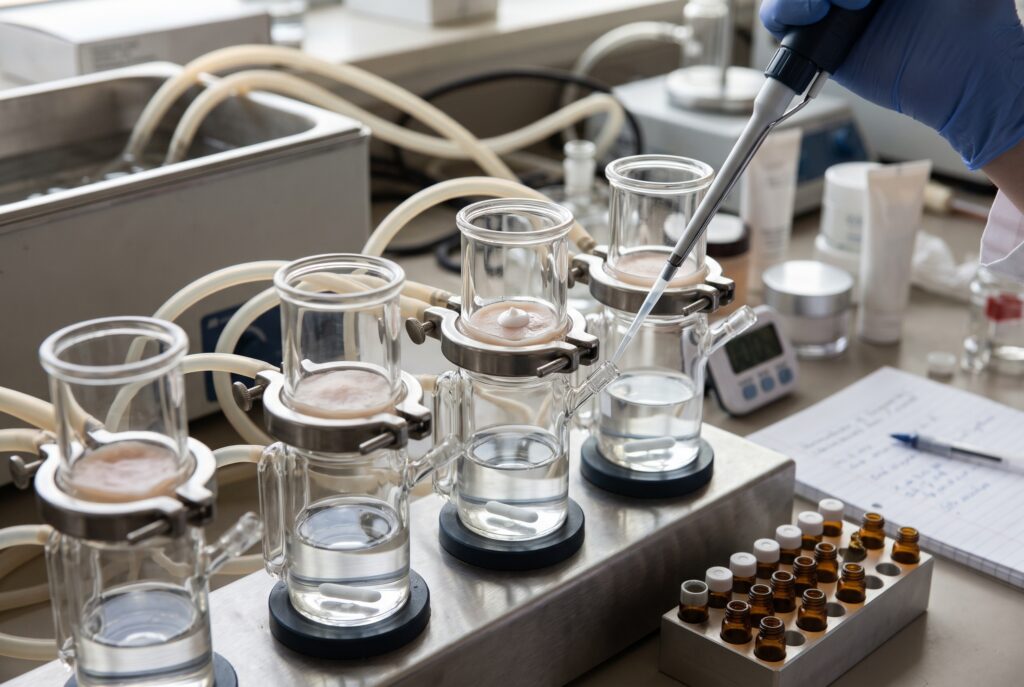
Two creams can sit side by side on a drugstore shelf with nearly identical base formulas, one promising to soften dry skin and the other to relieve eczema itch. Under US law, that difference in wording places them in separate regulatory worlds. Label and marketing collateral claims, not the ingredients alone, decide whether a product is a cosmetic or a drug, and that decision shapes the evidence regulators expect to see. Skin permeation testing works on both types of products.
For a cosmetic, skin permeation testing helps estimate how much of an ingredient crosses the skin, a key input to any safety assessment. For a topical drug, the same Franz diffusion cells help show whether a generic product delivers its active ingredient the way the reference product does. The sections below trace how that testing serves each category, from cosmetics through OTC monograph drugs to prescription and generic topicals, including products that FDA regulates as both.
Key Takeaways
- Intended use sets the category. The FDA classifies a topical product as a cosmetic, a drug, or both based on its claims, consumer perception, and ingredients.
- Eczema relief is a drug claim. OTC Monograph M016 permits an eczema itch-relief indication only for colloidal oatmeal skin protectants.
- FDA’s IVPT and IVRT guidances remain drafts. Both date to October 2022, while four related topical and bioequivalence guidances reached final status in 2026.
- MoCRA covers safety, not efficacy. Cosmetic safety substantiation records are mandatory, and advertising claims fall under FTC substantiation standards.
- Model choice follows purpose. Excised human skin anchors drug IVPT, while porcine skin, Skin-PAMPA, and reconstructed epidermis serve screening and safety roles.
What Is In Vitro Skin Permeation Testing?
Skin permeation testing measures how an active ingredient in a topical product moves into and through skin, or a skin substitute, under controlled laboratory conditions. A Franz cell is a vertical diffusion cell: A membrane separates a donor compartment holding the product from a receptor compartment that analysts sample over time. IVRT measures how fast an active ingredient leaves the formulation. IVPT measures how fast and how much of it crosses the skin.
A 2024 review in the European Journal of Pharmaceutical Sciences traces the technique to work by Franz in the 1970s.
In Vitro Release Testing (IVRT)
The FDA’s IVRT draft guidance describes IVRT as a way to assess the rate of drug release from a topical product. Once validated, an IVRT method can also support quality control and post-approval manufacturing changes.
IVRT uses a synthetic membrane, often a filtration membrane, rather than skin. The draft points to equipment described in USP General Chapter <1724>, including vertical diffusion cells and immersion cells. It cites a membrane surface temperature of 32°C ± 1°C for skin products and 37°C ± 1°C for mucosal products.
In Vitro Permeation Testing (IVPT)
The FDA’s IVPT draft guidance describes IVPT as a way to assess the rate and the extent to which a drug becomes available at or near a site of action in the skin. The draft recommends excised human skin as the membrane. It calls for a barrier integrity test on each skin section.
The draft defines two endpoints. Flux (J) captures the rate of permeation, in units such as ng/cm²/hr. Total cumulative amount (AMT) captures the extent. Flux profiles resemble plasma pharmacokinetic curves. The FDA notes that IVPT characterizes absorption only, not distribution, metabolism, or excretion.
Several design figures in the draft draw frequent attention:
- a minimum of eight nonzero sampling time points across the study, for example over 48 hours.
- a pilot study using 4–6 skin donors, with at least four replicate skin sections per donor per treatment group.
- skin dermatomed to a relatively consistent thickness across donors.
Need skin permeation or dermal absorption testing?
Submit a lab request to connect with laboratories that run these studies.
Where Does FDA Draw the Line Between Cosmetic and Drug Claims?
Under US law, a product’s intended use determines whether it is a cosmetic, a drug, or both. An eczema relief claim is a drug claim. A moisturizing claim is a cosmetic claim.
The FDA’s explainer “Is It a Cosmetic, a Drug, or Both?” quotes the statutory definitions. The FD&C Act defines cosmetics by purposes such as cleansing, beautifying, and altering the appearance. It defines drugs as articles intended to diagnose, cure, mitigate, treat, or prevent disease, or to affect the body’s structure or function.
The FDA lists three ways it establishes intended use:
- claims in labeling, advertising, websites, and other promotional materials.
- consumer perception, based on the product’s reputation.
- ingredients with a well-known therapeutic use, such as fluoride in toothpaste.
A product with both uses must meet both sets of requirements: The FDA cites an antidandruff shampoo as an example. The agency also notes that the term “cosmeceutical” has no meaning under the law.
The OTC Monograph Route for Eczema Claims
Nonprescription eczema claims have a defined path. OTC Monograph M016, the skin protectant final order, became effective under the CARES Act on March 27, 2020. It names eczema as a permitted use only for colloidal oatmeal products, alone or combined with mineral oil. The monograph sets a colloidal oatmeal minimum of 0.007%, or 0.003% in combination with mineral oil. M016 indication reads that the product temporarily protects and helps relieve minor skin irritation and itching due to eczema, among other listed conditions. Products that conform to M016 need no new drug application (NDA). As drugs, they still fall under drug labeling and GMP rules.
Claims outside the monograph’s scope, such as treating moderate atopic dermatitis, follow the NDA pathway. A generic version of an approved topical drug follows the abbreviated new drug application (ANDA) pathway. Permeation testing plays its largest regulatory role there.
How Do MoCRA and FTC Rules Apply to Cosmetic Claims?
Cosmetics follow a separate framework from drugs, and two agencies share oversight of their claims. The FDA enforces MoCRA’s safety requirements. The FTC polices advertising claims.
Under MoCRA, a responsible person must ensure and maintain records supporting adequate safety substantiation for each cosmetic product. The FDA states that neither the law nor its regulations require specific tests. It does expect the supporting data to come from scientifically robust methods. In the EU, the SCCS Notes of Guidance build dermal absorption into cosmetic ingredient safety evaluation.
MoCRA’s substantiation duty addresses safety and does not set an efficacy standard for marketing claims. The FTC’s December 2022 Health Products Compliance Guidance applies to health-related claims for products that include cosmetics and OTC drugs. It calls for competent and reliable scientific evidence and states that health-related benefit claims generally require randomized, controlled human clinical trials. The guidance describes itself as business guidance without the force of law.
Contract Laboratory covers the broader testing picture in A Laboratory Guide to Cosmetics Formulation Testing and its overview of claims substantiation testing.
Where FDA, EMA, and OECD Guidance Stands
Drug and cosmetic permeation work draws on different documents: The FDA and EMA guidance governs topical drug equivalence. OECD and SCCS documents govern dermal absorption for chemical and cosmetic ingredient safety.
Current Status of FDA’s Topical Framework
The FDA has finalized most of its topical generic framework, while its two core in vitro guidances, on IVPT and IVRT, remain in draft. Europe’s equivalent guideline has applied since April 2025.
Key Documents at a Glance
| Document | Issuer | Status as of October 2026 | Relevance to skin testing |
|---|---|---|---|
| In Vitro Permeation Test Studies for Topical Drug Products Submitted in ANDAs | FDA | Draft, October 2022 | IVPT method development, validation, and pivotal studies for generic topicals |
| In Vitro Release Test Studies for Topical Drug Products Submitted in ANDAs | FDA | Draft, October 2022 | IVRT method development and validation for generic topicals |
| Physicochemical and Structural (Q3) Characterization of Topical Drug Products Submitted in ANDAs | FDA | Final, March 2026 | Q3 sameness and its effect on what further BE evidence FDA recommends |
| Statistical Approaches to Establishing Bioequivalence | FDA | Final, May 2026 | Statistical approaches for IVRT and IVPT comparisons |
| Guideline on quality and equivalence of locally applied, locally acting cutaneous products | EMA | In effect since April 2, 2025 | Quality requirements, plus IVRT, IVPT, and tape stripping as alternatives to clinical equivalence studies |
| Test No. 428: Skin Absorption: In Vitro Method | OECD | Adopted 2004 | Diffusion cell method for chemical skin absorption |
| OECD Guidance Notes on Dermal Absorption Studies, No. 156 | OECD | Second edition, September 2022 | Interpretation of dermal absorption data for risk assessment |
| SCCS Notes of Guidance for the Testing of Cosmetic Ingredients | European Commission SCCS | 12th revision, adopted May 15, 2023 | EU cosmetic ingredient safety evaluation, including dermal absorption |
What Does OECD TG 428 Measure?
TG 428 accepts skin from human or animal sources, viable or non-viable. Both static and flow-through diffusion cells qualify. The guideline describes doses of 1–5 mg/cm² for solids and up to 10 µL/cm² for liquids. Viable skin is preferred, though nonviable skin is acceptable.
TG 428 serves regulatory dermal absorption work outside the drug space. A 2023 industry perspective in Regulatory Toxicology and Pharmacology notes that pesticide dermal absorption studies are mainly conducted under TG 428. Health Canada’s 2026 science policy note on in vitro dermal absorption cites TG 428 and the 2022 second edition of Guidance Notes 156.
How Drug IVPT and TG 428 Differ
The FDA’s IVPT draft compares a test product against a reference standard to support bioequivalence. TG 428 quantifies how much of a chemical crosses skin for exposure assessment. The two share hardware but differ in dosing, endpoints, and statistics: The FDA’s draft defines flux and cumulative amount as its endpoints, while TG 428 reports the distribution of the test substance across the test system over time.
Which Skin Model Fits Which Purpose?
Excised human skin remains the reference membrane for drug IVPT. Porcine skin, Skin-PAMPA, and reconstructed epidermis trade some fidelity for supply, cost, or throughput.
| Model | Description | Common uses | Documented limits |
|---|---|---|---|
| Excised human skin | Dermatomed skin from surgery or cadaver donors | Pivotal IVPT for generic topicals; TG 428 studies | Limited supply; donor-to-donor variability |
| Porcine skin | Ex vivo pig skin, often from the ear | Formulation screening; TG 428 accepts animal skin | Can overpredict permeation of some lipophilic actives |
| Synthetic membranes | Inert filtration membranes | IVRT release testing | Not a skin barrier; no permeation data |
| Skin-PAMPA | 96-well artificial membrane of certramide, free fatty acid, and cholesterol | High-throughput early screening of actives and vehicles | Passive diffusion only; correlation varies by compound |
| Reconstructed human epidermis (RhE) | Cultured, multilayer human keratinocyte tissue | Irritation (OECD TG 439) and corrosion (TG 431); exploratory permeation work | More permeable than human skin in a published clotrimazole study; epidermis only |
1. Human and Porcine Skin
The FDA’s IVPT draft recommends excised human skin for bioequivalence studies. Porcine skin often fills earlier development roles. A 2025 Molecular Pharmaceutics study found equivalent permeation results across marketed formulations in both porcine and human skin. Its authors concluded that porcine skin offers an alternative for ex vivo permeation profiling.
The two tissues do not always agree. A 2017 UCL doctoral thesis reported ibuprofen permeation far lower in human skin than in porcine skin. Caffeine permeation in Skin-PAMPA came closer to human skin values.
2. Skin-PAMPA
Skin-PAMPA adapts the parallel artificial membrane permeability assay to skin. A 2012 European Journal of Pharmaceutical Sciences paper introduced the model, built on synthetic certramides that mimic stratum corneum ceramides. The authors described it as a quick, cost-effective research tool for pharmaceutical and cosmetic work.
Nanocarrier work uses Skin-PAMPA as well. A Drug Delivery Letters study reported higher resveratrol permeability from liposomes and nanostructured lipid carriers. Ethosomes belong to the same family of lipid vesicle carriers.
3. Reconstructed Human Epidermis
RhE models anchor nonanimal irritation and corrosion testing under OECD TG 439 and TG 431. Researchers have also tested them as permeation membranes. A 2022 Pharmaceutics study used RhE in a modified IVPT for clotrimazole creams and observed higher permeability in RhE than in human skin. Its authors proposed comparing permeation profiles between products rather than drawing absolute conclusions.
RhE irritation testing is a staple of cosmetic toxicology testing. For hypoallergenic claims, clinical human repeat insult patch testing complements in vitro irritation data. Disease-state models add an eczema-specific option. A 2017 Frontiers in Medicine review describes RhE and skin equivalents treated with cytokines overexpressed in atopic dermatitis, or with silenced barrier genes.
Claim Tiers and the Evidence Each Draws On
The same in vitro methods serve different purposes at each regulatory tier. The table summarizes what the cited sources describe for US products.
| Claim tier | Example claim | Pathway | What the sources describe | Role of in vitro skin data |
|---|---|---|---|---|
| Cosmetic | Moisturizes dry skin | No premarket approval | MoCRA safety substantiation records; FTC substantiation for advertising claims | Dermal absorption and RhE irritation data for the safety case; vehicle screening |
| OTC monograph drug | Temporarily protects and helps relieve minor skin irritation and itching due to eczema | Conformity with M016; no NDA | Active ingredient, concentration, and labeling conditions; drug GMP | M016 names no permeation test; release testing can support product quality |
| Generic topical drug | Same indication as the reference drug | ANDA | Bioequivalence to the reference product, per product-specific guidance | Q3 characterization, IVRT, and IVPT under a characterization-based approach |
| New topical drug | Treats atopic dermatitis | NDA | Data adequate to show safety and effectiveness | Formulation development and selection |
Generic Topicals and EU Equivalence
For generic topicals, product-specific guidances set the study package. The FDA’s penciclovir cream guidance, revised in October 2022, lists Q3 characterization, an IVRT study, and an IVPT study. The doxepin hydrochloride cream guidance from the FDA specifies an unoccluded finite-dose IVPT design. Topical corticosteroids follow the vasoconstrictor approach in the July 2026 final guidance.
In the EU, the EMA cutaneous products guideline describes a stepwise approach that can establish equivalence without clinical endpoint studies.
What a Permeation Study Package Includes
The guidance documents define what a credible permeation study documents. The follwoing five elements recur.
- Quality system: Regulatory dermal absorption studies often run under Good Laboratory Practice (GLP). The OECD Principles of GLP apply to nonclinical safety testing of items in pharmaceutical, pesticide, and cosmetic products, among others. Under OECD’s Mutual Acceptance of Data system, data generated under OECD Test Guidelines and GLP in one adhering country must be accepted for assessment in the others.
- Skin sourcing: The FDA’s IVPT draft gives cadaver skin from the posterior torso as an example source. An FDA presentation from its 2022 topical generics workshop states that donor age, race, and sex be reported for all IVPT studies. OECD TG 428 accepts human or animal skin.
- Barrier integrity: The IVPT draft describes three test types: transepidermal water loss, tritiated water permeation, and electrical resistance.
- Analytical validation: The draft’s worked flux example uses a receptor concentration of 2.0 ng/mL. The IVPT draft calls for a validated analytical method and references FDA’s 2018 Bioanalytical Method Validation guidance. It also calls for qualifying the receptor solution for drug solubility and stability.
- Mass balance: TG 428 and OECD Guidance Document 28 require mean recovery of 90–110% for nonvolatile test chemicals, according to a Regulatory Toxicology and Pharmacology analysis of the EFSA database. The 2024 review notes that many published studies report permeation alone. They omit the amount of active left on and in the skin at study end.
Matching the Study to the Claim
A product’s claims set its regulatory tier, and the tier shapes which skin data carries weight. A cosmetic moisturizer, an M016 skin protectant, and a generic corticosteroid cream can all use Franz cells, but for different questions and under different documents.
Contract Laboratory connects cosmetic, OTC, and topical drug developers with laboratories that offer IVRT, IVPT, OECD TG 428 dermal absorption, Skin-PAMPA, and reconstructed epidermis testing. Our roundup of top cosmetic testing labs and CROs profiles additional providers, and the network also covers related toxicology and biocompatibility testing and pharmacology and drug development services.
Connect on Contract Laboratory
- Submit a Request: Developers can post IVRT, IVPT, dermal absorption, or skin model testing needs and receive proposals from qualified laboratories.
- View Requests: Laboratories and CROs can browse open testing requests, including cosmetic and topical product projects.
- Register Your Lab: Laboratories offering Franz cell, skin permeation, or reconstructed epidermis services can list their capabilities on the network.
This article was created with the assistance of Generative AI and has undergone editorial review before publishing.
Sources and Further Reading
- FDA, FDA Drug Competition Action Plan, content current as of August 17, 2026
- FDA, In Vitro Permeation Test Studies for Topical Drug Products Submitted in ANDAs, draft, October 2022
- FDA, In Vitro Release Test Studies for Topical Drug Products Submitted in ANDAs, draft, October 2022
- FDA, Physicochemical and Structural (Q3) Characterization of Topical Drug Products Submitted in ANDAs, final, March 2026
- Federal Register, May 29, 2026 notice on bioequivalence guidances
- FDA, Topical Dermatologic Corticosteroids: In Vivo Bioequivalence, final, July 2026
- FDA, Is It a Cosmetic, a Drug, or Both? (Or Is It Soap?)
- FDA, Modernization of Cosmetics Regulation Act of 2022 (MoCRA), content current as of August 10, 2026
- FDA, OTC Monograph M016: Skin Protectant Drug Products, final administrative order
- FTC, Health Products Compliance Guidance, December 2022
- EMA, Guideline on quality and equivalence of locally applied, locally acting cutaneous products
- OECD, Test No. 428: Skin Absorption: In Vitro Method, 2004
- OECD, Test No. 439: In Vitro Skin Irritation: Reconstructed Human Epidermis Test Method
- OECD, Principles of Good Laboratory Practice, as revised in 1997
- European Commission SCCS, Notes of Guidance, 12th revision, 2023
- Lane ME, In vitro permeation testing for the evaluation of drug delivery to the skin, European Journal of Pharmaceutical Sciences, 2024
- Sinkó B et al., Skin-PAMPA: a new method for fast prediction of skin penetration, European Journal of Pharmaceutical Sciences, 2012
- Agonia AS et al., Reconstructed Human Epidermis: An Alternative Approach for In Vitro Bioequivalence Testing of Topical Products, Pharmaceutics, 2022
- Peters RHW et al., Advantages and limitations of in vitro models for atopic dermatitis: A consensus expert opinion, Journal of Investigative Dermatology, 2026
Frequently Asked Questions (FAQs)
Both. For cosmetics, dermal absorption and reconstructed epidermis data can feed the safety substantiation that MoCRA requires, and permeation studies help formulators compare vehicles. For topical drugs, IVRT and IVPT help generic developers show bioequivalence to a reference product. Products with both intended uses, such as moisturizers that also claim sun protection, must meet both cosmetic and drug requirements.
IVRT measures how fast an active ingredient leaves a topical product, typically across a synthetic membrane. IVPT measures the rate and extent to which the active permeates into and through skin. FDA’s draft IVPT guidance recommends excised human skin as the membrane, and both tests commonly run in vertical diffusion cells.
A Franz cell is the classic vertical diffusion cell design, with a membrane clamped between a donor compartment and a receptor compartment. FDA’s IVRT draft guidance points to the vertical diffusion cell equipment described in USP General Chapter <1724>.
Claims to treat or relieve eczema are drug claims under FDA’s intended-use framework. OTC Monograph M016 permits labeling stating that a colloidal oatmeal skin protectant temporarily protects and helps relieve minor skin irritation and itching due to eczema. Products carrying that claim are OTC drugs subject to drug labeling and GMP requirements.
No. FDA states that neither MoCRA nor FDA regulations require specific tests to demonstrate cosmetic safety. MoCRA requires records supporting adequate safety substantiation, and FDA expects the underlying data to come from scientifically robust methods.
TG 428 describes an in vitro diffusion cell method for measuring how much of a test substance absorbs through skin. It accepts human or animal skin and both static and flow-through cells. It supports chemical, pesticide, and cosmetic ingredient safety assessment rather than drug bioequivalence.
Published studies describe Skin-PAMPA as a fast, cost-effective screening tool. Reported correlations with porcine and human skin vary by compound and dosing conditions. For bioequivalence studies, FDA’s IVPT draft guidance recommends excised human skin.