
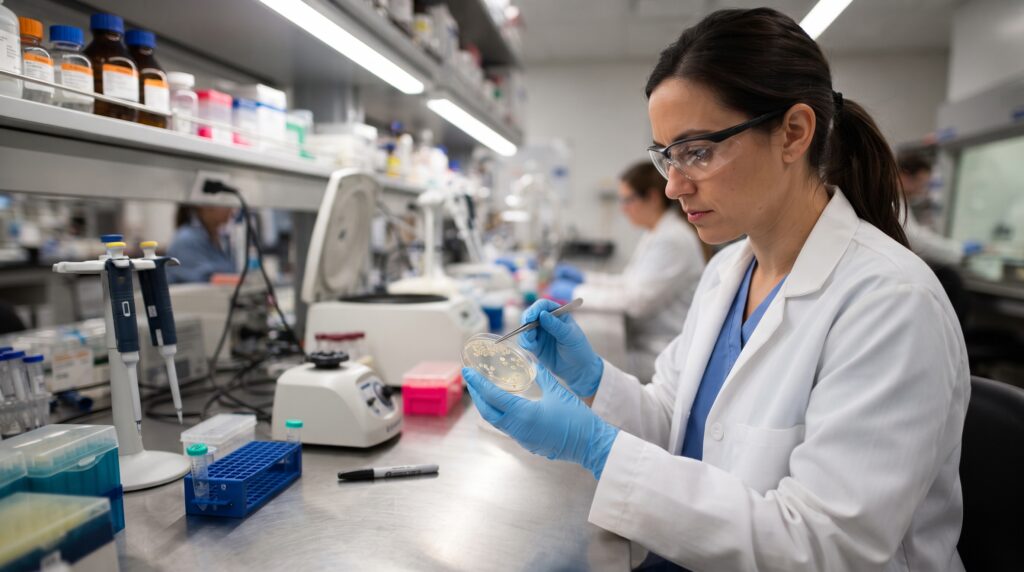
Food manufacturers face growing pressure to verify safety, prove label accuracy, and demonstrate regulatory compliance at every stage of production. Outsourcing that work to an accredited food testing laboratory is often more practical than building in-house capacity, but choosing the right partner requires understanding what these labs test, how accreditation works, and what to expect once you submit a sample. This guide breaks down the core services, credentials, and evaluation criteria manufacturers need to make that decision with confidence.
Key Takeaways
- Outsourced food testing gives manufacturers access to accredited labs without the cost of building an in-house facility.
- Recognized accreditation, such as ISO/IEC 17025 or, in certain cases, FDA’s LAAF program, signals a lab’s technical competence and result reliability.
- Core services span microbiology, nutritional analysis, shelf-life, FSMA-related testing, and authenticity screening, each with distinct turnaround expectations.
- Evaluating a lab’s accreditation scope, method validation, and chain of custody practices reduces risk before you submit samples.
What Is a Food Testing Laboratory, and Why Outsource Testing?
A food testing laboratory analyzes raw materials, in-process samples, and finished products to verify safety, nutritional accuracy, and regulatory compliance. Outsourcing this work to a third-party or contract food testing laboratory gives manufacturers access to accredited labs, validated methods, and trained analysts without the capital cost of building an in-house facility. Building that capability internally means investing in specialized instrumentation, method validation, and analysts trained specifically on food matrices. Those costs are difficult to justify below a certain production volume. A contract food testing laboratory typically supports the full product lifecycle: raw material qualification, in-process monitoring, finished product release, and post-market verification.
This work underpins compliance with the Food Safety Modernization Act (FSMA), substantiates nutrition and health claims, and produces the documented evidence manufacturers need if a regulator, retailer, or customer requests proof of safety. For companies without the volume to justify permanent lab infrastructure, a contract lab relationship scales testing capacity up or down with production needs.
Why Accreditation Matters When Choosing a Food Testing Lab
Accreditation status is one of the clearest signals of a food testing lab’s reliability. ISO/IEC 17025, the international standard for the competence of testing and calibration laboratories, requires labs to demonstrate technical competence, method validation, and consistent, unbiased results. Independent accreditation bodies assess labs against these requirements before granting certification, giving manufacturers confidence that results will withstand regulatory or legal scrutiny. In the United States, organizations such as A2LA and ANAB, two of the leading accreditation bodies, carry out these assessments. Both are signatories to the International Laboratory Accreditation Cooperation (ILAC) Mutual Recognition Arrangement, so peer accreditation bodies elsewhere recognize accreditation from either one.
For certain FSMA-related testing, the Food and Drug Administration (FDA) has gone further with the Laboratory Accreditation for Analyses of Foods (LAAF) program. Under LAAF, only labs accredited by an FDA-recognized accreditation body may perform testing tied to specific high-risk circumstances, such as import alert removal or a directed food laboratory order. A2LA and ANAB are both current FDA-recognized accreditation bodies for LAAF, among a small number of organizations the agency has approved for this purpose. Manufacturers with import-heavy supply chains should confirm whether their testing needs fall under LAAF’s scope before selecting a lab, since general ISO/IEC 17025 accreditation alone will not satisfy those specific requirements.

Core Services Offered by Contract Food Testing Laboratories
Most full-service contract food testing laboratories organize their offerings around a handful of core service lines. Each addresses a distinct risk category, and manufacturers often need more than one to fully cover a single product line.
1. Microbiology and pathogen testing
Screening for organisms such as Listeria, Salmonella, and E. coli, along with spoilage and indicator organisms, is central to any food safety program. Outsourced food microbiology testing services cover both routine environmental monitoring and finished product release testing. Coverage increasingly extends to non-bacterial threats, too: a 2026 multistate outbreak linked to Cyclospora in fresh produce showed how standard swabs can miss parasitic contamination that requires dedicated molecular methods. Established Salmonella testing protocols remain the backbone of most pathogen programs, spanning culture-based, polymerase chain reaction (PCR), and immunoassay methods.
2. Nutritional analysis and label compliance
Accurate nutrition facts panels depend on proximate analysis and other quantitative testing, guided by FDA’s food labeling guidance. Labs offering food science and nutritional analysis testing help manufacturers substantiate claims, and this category has grown more technical as the 2025–2030 Dietary Guidelines reshape testing priorities around heavy metals limits and label substantiation.
3. Shelf-life and stability testing
Validating a “best by” or expiration date requires real-time or accelerated stability studies. Shelf-life and stability testing services generate the data manufacturers need to support product dating with confidence, and this work often overlaps with microbiology testing to confirm a product stays microbiologically safe across its stated shelf life.
4. FSMA and preventive controls testing
Environmental monitoring, hazard analysis support, and preventive controls verification fall under this category. FSMA compliance testing services help manufacturers demonstrate they meet FDA’s prevention-focused food safety requirements, an area of growing complexity as FSMA 204 traceability rules take full effect.
5. Authenticity and fraud testing
Species identification, DNA-based testing, and adulteration screening protect against economically motivated food fraud. Food authenticity and fraud testing services increasingly draw on genetics and genomic testing capabilities as supply chains grow more complex and global.
For background on the underlying detection science, including pathogen methods, allergen thresholds, and emerging contaminants, see our companion guide to food safety testing methods, standards, and emerging threats.
Turnaround Times for Food Testing Services
Turnaround expectations vary significantly by test complexity and method.
| Testing category | What it evaluates | General turnaround range |
|---|---|---|
| Microbiology and pathogen testing | Presence of pathogenic, indicator, or spoilage organisms | Rapid screening (PCR, enzyme-linked immunosorbent assay): 24 to 48 hours. Culture confirmation: 5 to 7 days |
| Nutritional analysis | Proximate composition for nutrition facts panels | Varies by panel size and method; confirm with your lab |
| Shelf-life and stability | Product quality and safety over time | Weeks to months, depending on study design |
| FSMA and environmental monitoring | Preventive controls and environmental pathogen presence | Varies by scope; often aligned with microbiology turnaround |
| Authenticity and fraud testing | Species identification, adulterants, and mislabeling | Varies by method (PCR-based tests are faster than full sequencing) |
These ranges are general guidance rather than fixed industry standards; turnaround depends heavily on the specific method, sample matrix, and lab capacity. Manufacturers under regulatory or retailer deadlines should confirm exact turnaround, rush testing options, and reporting formats directly with their lab, including whether the lab can deliver results in structured data formats rather than PDF-only reports, since some traceability systems now require machine-readable Certificates of Analysis.
How to Choose the Right Food Testing Laboratory Partner
Selecting a contract laboratory is as much about process and documentation as it is about instrumentation. Before signing on with a partner, manufacturers should evaluate:
- Accreditation scope, including whether it covers the specific matrices and analytes it tests
- Method validation practices and alignment with AOAC International or other recognized reference methods
- Chain of custody procedures for sample handling and documentation
- Data integrity and electronic reporting capabilities, including structured formats for traceability systems
- Communication practices for out-of-specification or presumptive positive results
- Capacity for rush turnaround during recalls or time-sensitive product launches
A lab that can speak clearly to each of these points is generally better positioned to support routine testing and higher-stakes situations, such as a suspected contamination event or an FDA import alert. It’s worth verifying accreditation directly through the accrediting body’s public scope directory rather than relying only on a lab’s own marketing materials, since accreditation scope can change and a lab may let a specific method lapse without updating its website.
Find an Accredited Food Testing Laboratory through Contract Laboratory
Choosing the right outsourced testing partner protects your brand, your customers, and your regulatory standing. The right lab combines accreditation, method validation, and responsive communication, so testing supports your launch timeline instead of slowing it down.
Need food testing? Submit a lab request to connect with and get quotes from industry experts.
This content includes text that has been generated with the assistance of AI.
Frequently Asked Questions
A manufacturer owns and operates an in-house lab directly, while a contract laboratory performs testing as a third party, typically under its own accreditation and quality system. Contract labs offer flexibility for manufacturers without the volume to justify permanent testing infrastructure.
General ISO/IEC 17025 accreditation isn’t a universal requirement, but many retailers, auditors, and regulators expect it. For certain FSMA-related testing, FDA’s LAAF program requires accreditation by a recognized accreditation body before a lab can perform that specific work.
Testing frequency depends on the product, process controls, and regulatory requirements. A manufacturer’s food safety plan or Hazard Analysis and Critical Control Point program typically sets that frequency, rather than a fixed industry schedule.
A presumptive positive from a rapid screening method requires culture confirmation before the manufacturer can release or reject the lot. The lab should have a documented protocol for communicating presumptive results quickly so manufacturers can hold affected product.
Most full-service contract laboratories handle both, though imported food testing tied to specific FDA circumstances, such as import alert removal, may require a LAAF-accredited laboratory specifically.
Most manufacturers need a combination: microbiology for safety, nutritional analysis for labeling, and shelf-life testing for dating claims, with FSMA and authenticity testing layered on depending on product risk and supply chain complexity. A lab with cross-disciplinary capabilities can typically map these needs to your specific product and formulation during an initial consultation, rather than requiring you to guess at the right service mix upfront.