
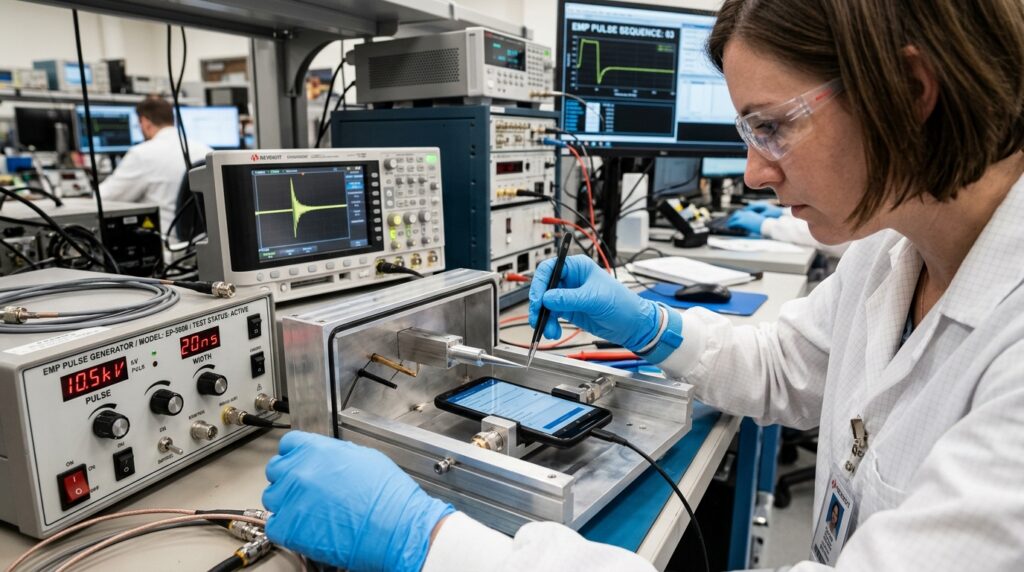
Introduction: Why RF and EMF Testing Matter
Wireless communication devices, power infrastructure, industrial machinery, medical equipment, and consumer electronics all emit electromagnetic energy. Whether a product is a 5G smartphone, a Wi-Fi router, an electric vehicle charger, a medical imaging device, or an industrial motor, understanding and measuring its electromagnetic emissions is central to product safety certification, regulatory approval, worker protection, and market access.
The terms “RF radiation” and “EMF radiation” are related but describe different slices of the electromagnetic phenomena, and the testing methods, regulatory frameworks, and safety limits that apply to each are distinct. This guide explains the difference, the global regulatory landscape (FCC, ICNIRP 2020, IEC standards), and what laboratory testing for RF and EMF compliance involves.
ContractLaboratory.com connects product manufacturers, wireless device developers, power system operators, and compliance teams with accredited safety certification laboratories and electronics and electrical testing specialists experienced in RF exposure compliance, SAR testing, EMF measurement, and EMC testing.
The Electromagnetic Spectrum: From Power Lines to Gamma Rays
All electromagnetic radiation — from the 50/60 Hz fields generated by household power lines to the gamma rays emitted by radioactive materials — occupies positions on a continuous electromagnetic spectrum characterized by frequency (Hz) and wavelength (m). The most critical dividing line on this spectrum for health and safety regulation is the distinction between non-ionizing and ionizing radiation:
| Radiation type | Frequency range | Examples | Nerve/muscle stimulation at high field strengths; WHO/IARC Group 2B (childhood leukemia association at >0.3–0.4 μT). Established adverse effects require fields exceeding ICNIRP limits. |
| Non-ionizing (ELF-EMF) | 0–300 Hz (extremely low frequency) | Power lines (50/60 Hz), transformers, electric motors, MRI magnets | Nerve/muscle stimulation at high field strengths; WHO/IARC Group 2B (childhood leukemia association at >0.3–0.4 μT). Established adverse effect requires fields exceeding ICNIRP limits. |
| Non-ionizing (intermediate frequency) | 300 Hz–100 kHz | Induction heating, anti-theft gates, wireless charging (Qi), smart meters | Both nerve stimulation (low end) and heating (high end); covered by ICNIRP 2010 low-frequency guidelines and IEC 62311. |
| Non-ionizing (RF/microwave) | 100 kHz–300 GHz | Mobile phones, Wi-Fi, Bluetooth, 5G, microwave ovens, radar, satellite | Thermal (heating) effect — the only established adverse health effect at levels above regulatory limits. SAR (W/kg) is the primary dosimetric quantity below 6 GHz; absorbed power density above 6 GHz. WHO/IARC Group 2B for RF. |
| Non-ionizing (optical) | 300 GHz–400 THz (infrared/visible/UV-A) | LEDs, lasers, UV lamps | Photochemical and thermal retinal/skin damage. Different regulatory framework (ICNIRP optical guidelines; IEC 60825 laser safety). |
| IONIZING radiation | Above ~3 PHz (X-rays, gamma rays, cosmic rays, particle radiation) | X-ray machines, CT scanners, nuclear medicine, radioactive materials | Can ionize atoms and break DNA bonds directly. Carcinogenic. Regulated entirely separately from EMF (nuclear regulatory authorities, IAEA, NRC, etc.) |
Key distinction: RF radiation and EMF from power lines are non-ionizing. They do not have sufficient photon energy to break chemical bonds or ionize atoms. Their established biological effect — at field strengths exceeding regulatory thresholds — is thermal (heating body tissue). This is fundamentally different from ionizing radiation such as X-rays, which can directly damage DNA. RF and EMF safety limits are set to prevent heating effects, not to prevent ionization.
RF Radiation vs. EMF: How the Terms Relate
RF (Radio Frequency) Radiation
RF radiation refers specifically to oscillating electromagnetic fields in the frequency range associated with radio communications and microwave energy, broadly 100 kHz to 300 GHz (the range covered by ICNIRP 2020 and IEC 62232). RF radiation is produced by any device that transmits or receives wireless signals: mobile phones, cellular base stations, Wi-Fi routers, Bluetooth devices, radar systems, satellite uplinks, and microwave ovens. RF radiation is characterized by frequency (Hz), wavelength (m), and — for exposure assessment — by field strength (V/m for electric field; A/m for magnetic field), power density (W/m² or mW/cm²), and, for tissue absorption, Specific Absorption Rate (SAR, in W/kg).
RF radiation is the more commercially significant testing category for consumer electronics and wireless devices, because virtually every wireless device sold globally requires RF exposure compliance testing before market authorization.
EMF (Electromagnetic Field) Radiation
EMF is a broader term encompassing the entire electromagnetic spectrum of oscillating electric and magnetic fields, including ELF-EMF (50/60 Hz from power infrastructure), intermediate frequencies (wireless charging, induction heating), and the RF range. EMF testing is therefore both a broader category (applying to anything from power lines to mobile phones) and commonly used in industry to refer specifically to the ELF-EMF range from power lines, transformers, substations, and electrical appliances — the frequency range where field strength is measured in tesla (T) or gauss (G) rather than watts per kilogram.
In commercial practice, when a manufacturer says they need “SAR testing” or “RF exposure testing,” they typically mean RF-range compliance. When a power utility, EV manufacturer, or facilities manager says they need “EMF testing,” they often mean ELF-EMF magnetic field measurement. The term “EMF testing” in product compliance contexts also broadly covers both RF and ELF assessments.
SAR: The Primary RF Exposure Metric for Mobile and Wireless Devices
SAR — Specific Absorption Rate — is the rate at which energy is absorbed by the human body when exposed to a radio frequency electromagnetic field. It is expressed in watts per kilogram (W/kg), and represents the fundamental biological dosimetric quantity for RF exposure from devices that are held close to or in contact with the body. SAR is the primary metric tested for every mobile phone, tablet, smartwatch, and wearable device that requires regulatory certification.
Global SAR limits
- United States (FCC): 1.6 W/kg averaged over 1 gram of tissue (for head and trunk exposure from devices held against the body). FCC regulations: Part 1, Sections 1.1307 and 1.1310; FCC OET Bulletin 65 provides evaluation procedures.
- European Union / ICNIRP: 2.0 W/kg averaged over 10 grams of tissue. Based on ICNIRP guidelines (1998 for the general public; updated in 2020). EU Radio Equipment Directive (RED) 2014/53/EU requires RF exposure assessment for all radio equipment.
- Canada (ISED): 1.6 W/kg (same as US), per Health Canada Safety Code 6 and ISED RSS-102.
- Australia (ARPANSA): 2.0 W/kg averaged over 10 g, per ARPANSA Radiation Protection Standard (2002, under review for 2021 update); follows ICNIRP framework.
- Japan (MIC / TELEC): 2.0 W/kg over 10 g, consistent with ICNIRP.
How SAR testing is performed
SAR testing for mobile and close-to-body devices uses a liquid-filled anatomical phantom — a model of the human head or body filled with a tissue-simulating liquid matched to the dielectric properties of human tissue at the test frequency. The industry-standard test systems include SPEAG’s DASY6 (Dosimetric Assessment System) using miniaturized probes and robotic scanning. Key procedural elements:
- Test configurations: Device tested at worst-case positions (against head, held in hand, against body) in all transmit modes and at maximum output power.
- Phantom: SAM (Specific Anthropomorphic Mannequin) phantom for head testing per IEC/IEEE 62209-1528; flat phantom for body/limb testing.
- Frequency range below 6 GHz: SAR (W/kg) averaged over 1g (FCC) or 10g (ICNIRP) of simulated tissue.
- Frequency range above 6 GHz (relevant for 5G mmWave): Power density (W/m²) replaces SAR as the primary metric; ICNIRP 2020 specifies limits averaged over 4 cm² and 1 cm² at higher frequencies. OTA (Over-the-Air) measurements in anechoic chambers are required.
Regulatory Frameworks for RF and EMF Testing
United States: FCC Rules and OET Bulletin 65
The FCC is the primary US regulatory body for RF emissions and RF exposure from wireless devices and infrastructure. The core rules:
- FCC Part 15: Unlicensed radio frequency devices (Wi-Fi, Bluetooth, short-range devices). Requires RF exposure evaluation; many low-power devices qualify for categorical exclusion under specific power/separation thresholds.
- FCC Parts 22, 24, 25, 27, 90, 95, 96: Licensed mobile and wireless communication services (cellular, PCS, AWS, broadband, CBRS). Require FCC equipment authorization with RF exposure demonstration.
- FCC OET Bulletin 65 (OET-65): “Evaluating Compliance with FCC Guidelines for Human Exposure to Radiofrequency Electromagnetic Fields” — the technical guidance document for RF exposure evaluation, providing formulas for Maximum Permissible Exposure (MPE) calculations and SAR test procedures.
- FCC KDB Publications: Technical guidance for specific device types (e.g., KDB 447498 for SAR testing procedures; KDB 616217 for unlicensed devices).
- Occupational vs. general public limits: FCC sets two tiers: occupational/controlled exposure (for workers aware of and able to control their exposure) is typically 5× less restrictive than general public/uncontrolled exposure limits.
International: ICNIRP 2020 Guidelines
The International Commission on Non-Ionizing Radiation Protection (ICNIRP) publishes the guidelines adopted by most countries outside North America, including EU member states, Australia, Japan, and many others. The current guidelines for RF (100 kHz–300 GHz) are ICNIRP 2020, which replaced ICNIRP 1998 as the foundational international reference for RF safety limits.
ICNIRP 2020 key features and differences from 1998:
- 5G-specific additions: New restrictions specifically addressing EMF frequencies above 6 GHz, where 5G millimeter-wave technologies operate. Localized exposure restrictions with smaller averaging areas (4 cm² and 1 cm²) protect against focused beam exposure from mmWave antennas.
- Brief exposure restriction: New restrictions for RF EMF exposures shorter than 6 minutes to ensure the transient temperature rise does not cause harm — relevant for pulsed technologies.
- Above 6 GHz: Absorbed power density (Sab, W/m²) replaces SAR as the basic restriction for >6 GHz; 20 W/m² averaged over 4 cm² (local exposure ≥6 min, general public). An additional 1 cm² restriction above 30 GHz for focused beams.
- General public vs. occupational: Occupational limits are 5× less restrictive than general public limits, reflecting that workers are aware of their exposure and can exercise control.
Key Product Testing Standards
| Standard | Issuing body | Scope and application |
| IEC 62232:2022 (4th ed.) | IEC | Assessment of electronic and electrical equipment related to human exposure restrictions (0 Hz–300 GHz). Broad standard covering finished products; used as a primary standard in CE marking process for EU Radio Equipment Directive. |
| IEC 62311:2019 | IEC | US standard for safety levels with respect to human exposure to EMFs (0–300 GHz). Used as an alternative or complement to ICNIRP for US market; similar framework with some differences in limits and averaging. |
| IEC/IEEE 62209-1528:2020 | IEC/IEEE | Measurement procedure for SAR using vector measurement techniques for mobile phones, tablets, and other devices held at or near the ear and body. The primary global SAR test method standard. |
| IEEE C95.1-2019 | IEEE | US standard for safety levels with respect to human exposure to EMFs (0–300 GHz). Used as an alternative or complement to ICNIRP for the US market; a similar framework with some differences in limits and averaging. |
| IEEE C95.3-2021 | IEEE | Measurement of potentially hazardous electromagnetic fields — RF and microwave. Standard for field measurement methodology, instrument requirements, and uncertainty analysis. |
| ICNIRP 2010 ELF guidelines | ICNIRP | Guidelines for limiting exposure to time-varying electric and magnetic fields, 1 Hz–100 kHz. Covers ELF-EMF from power lines, transformers, substations, and electrical equipment. Adopted by EU Directive 2013/35/EU for worker protection. |
| FCC OET Bulletin 65 | FCC | Evaluation of RF field strength and SAR in the vicinity of base stations, 100 kHz–300 GHz. Used for cellular towers, small cells, 5G base stations, and smart meter networks. Defines measurement procedures for both near-field and far-field scenarios. |
ELF-EMF Testing: Power Lines, Substations, and Industrial Equipment
Extremely Low Frequency EMF (ELF-EMF), at 50 Hz (European grid frequency) and 60 Hz (North American/Japanese grid frequency), is generated by power lines, transformers, distribution substations, electric motors, large appliances, and — increasingly — electric vehicle (EV) charging systems. ELF-EMF is measured in tesla (T) or the CGS unit gauss (G) using calibrated gaussmeters or three-axis fluxgate magnetometers (1 μT = 10 mG).
ICNIRP 2010 ELF exposure limits (general public)
- Magnetic field (50/60 Hz): 200 μT (2000 mG) reference level for the general public; 1000 μT (10,000 mG) for occupational/controlled environments. For context: typical residential background fields are 0.01–0.1 μT; directly under high-voltage transmission lines may reach 1–10 μT.
- Electric field (50/60 Hz): 5 kV/m reference level for the general public; 10 kV/m occupational.
Health classification and regulatory context
In 2001, the WHO International Agency for Research on Cancer (IARC) classified ELF-EMF as Group 2B — possibly carcinogenic to humans, based primarily on epidemiological studies suggesting an association between childhood leukemia and magnetic field exposures above approximately 0.3–0.4 μT. The Group 2B classification indicates limited evidence of carcinogenicity in humans and does not constitute proof of a causal relationship — it means the evidence is not sufficient to rule out an association. EU Directive 2013/35/EU mandates that employers assess and manage ELF-EMF exposure for workers near high-field sources.
ELF-EMF testing applications
- Electric vehicle (EV) chargers: Both wired AC charging and wireless (inductive) EV charging systems require ELF and intermediate-frequency EMF assessment per IEC 62232 / ICNIRP 2010 / SAE J2954 (for wireless charging).
- Power infrastructure: Substation EMF surveys, high-voltage line corridor assessments, and smart meter EMF evaluation use calibrated fluxgate magnetometers and electric field meters.
- Medical devices: MRI magnets produce extremely strong static (DC) and time-varying (gradient and RF) fields. Worker and patient exposure assessment per IEC 60601-2-33 and ICNIRP guidelines is required.
- Industrial equipment: Large induction heaters, arc welders, and motor drive systems can produce strong ELF fields requiring occupational EMF assessments per EU Directive 2013/35/EU.
5G and Millimeter Wave Testing: New Challenges at High Frequencies
5G wireless networks introduce testing challenges that did not exist with previous cellular generations. 5G operates in two frequency bands with fundamentally different propagation and dosimetry characteristics:
- 5G FR1 (Frequency Range 1, sub-6 GHz, 450 MHz–6 GHz): Uses the same SAR-based testing framework as 4G LTE. However, 5G FR1 devices may simultaneously transmit on 4G, Wi-Fi 6/7, and Bluetooth frequencies — requiring multi-band simultaneous SAR evaluation at worst-case simultaneous transmit scenarios.
- 5G FR2 (Frequency Range 2, millimeter wave, 24–52 GHz): SAR is no longer the appropriate dosimetric quantity — at these frequencies, RF energy is absorbed in the skin surface layer rather than deep tissue. ICNIRP 2020 specifies power density limits (W/m²) averaged over 4 cm² for localized exposure and 1 cm² for focused beam exposure above 30 GHz. Testing uses power density measurements rather than SAM phantom SAR scanning.
- OTA (Over-The-Air) testing in anechoic chambers: 5G mmWave devices use beam-forming antenna arrays that cannot be assessed with traditional near-field probe scanning. Radiated power measurements in calibrated anechoic chambers (total radiated power, TRP; total isotropic sensitivity, TIS; and equivalent isotropic radiated power, EIRP) are required for mmWave device authorization.
- Multi-antenna / MIMO considerations: 5G base stations using massive MIMO (multiple input multiple output) with dozens or hundreds of antenna elements require a complex power density assessment. IEC 62232:2022, 4th edition, specifically addresses evaluation methodologies for these complex antenna systems.
The FCC updated its exemption thresholds in 2019 (FCC 19-126), creating new unified exemption categories. For 5G devices: those operating above 6 GHz with power below specified thresholds may qualify for categorical exclusion, but multi-band simultaneous transmissions (5G + Wi-Fi + Bluetooth) often require actual SAR/power density testing even when individual bands would be exempt in isolation.
Products Requiring RF and EMF Compliance Testing
Virtually every wireless product sold in regulated markets requires some form of RF exposure assessment before authorization. The specific standard and test method depend on device type, frequency bands, and target market:
- Mobile phones and tablets: Full SAR testing per IEC/IEEE 62209-1528, FCC KDB 447498. Both head (against ear) and body (held against torso) positions were tested among the highest-volume SAR testing categories globally.
- Wearable devices (smartwatches, fitness bands, AR/VR headsets): Close-to-body devices require SAR testing; test separation and phantom configuration depend on wear position and device design. Wearables present unique challenges due to skin contact positioning.
- Wi-Fi routers, access points, and mesh systems: FCC Part 15 + SAR/MPE evaluation. Many qualify for categorical exclusion at typical mounting distances, but require MPE demonstration.
- Bluetooth devices: FCC reduced Bluetooth exemption threshold from 10 mW to 3 mW (at ≤5 mm separation) in 2025, meaning more low-power Bluetooth devices now require SAR testing.
- IoT devices (smart home, smart meters, LPWAN): FCC Part 15 authorization; RF exposure evaluation; many operate at sub-mW power levels qualifying for categorical exclusion, but duty cycle and proximity to body must be assessed.
- Wireless EV chargers (Qi, SAE J2954): Inductive charging systems operating at 80–90 kHz are intermediate-frequency EMF sources. IEC 62232, SAE J2954, and ICNIRP intermediate-frequency guidelines apply.
- 5G small cells and base stations: IEC 62232:2022 for RF field strength assessment around the antenna; ICNIRP 2020 or IEEE C95.1 exposure limits; cumulative assessment required when multiple transmitters are co-located.
- Wireless medical devices and RF-emitting implants: IEC 60601-1-2 (EMC requirements for medical electrical equipment) governs electromagnetic immunity and emissions. RF exposure from therapeutic and diagnostic medical devices may also fall under FDA/IEC regulatory requirements. Active implantable devices (pacemakers, neurostimulators) have specific interaction assessment requirements with ambient RF fields.
- Industrial RF equipment (induction heaters, dielectric heaters): High-power industrial RF sources require occupational EMF assessment; ICNIRP 2010 ELF and 2020 RF guidelines; IEEE C95.1; national occupational safety regulations.
RF and EMF Measurement Instruments and Methods
RF field measurement (100 kHz–300 GHz)
- Isotropic field probes: Calibrated three-axis electric field (V/m) and magnetic field (A/m) probes that measure total field strength independently of orientation. Used for far-field compliance measurements at a distance from antennas.
- Spectrum analyzers: Measure frequency-resolved power and field strength; essential for multi-band environments where signals from multiple sources must be individually characterized.
- SAR measurement systems: Robotic probe scanning systems (e.g., SPEAG DASY6, INDEXSAR SARA) with miniaturized E-field probes, SAM/flat phantoms, and tissue-simulating liquid. Used for mobile device SAR testing.
- Anechoic chambers: Shielded, anechoic (echo-free) rooms with RF absorber lining; required for OTA testing of 5G mmWave devices, antenna pattern measurements, and total radiated power tests.
ELF-EMF measurement (0–300 Hz)
- Gaussmeters / fluxgate magnetometers: Calibrated three-axis magnetic field meters measuring in tesla or gauss. Standard instruments for power line and substation EMF surveys. Typical measurement range: 0.01 μT to 100 mT.
- Electric field meters: Plate-type or ball-type sensors measuring the electric field in kV/m. Used for high-voltage transmission line assessments and substation safety surveys.
- Low-frequency spectrum analyzers: For frequency-resolved analysis in environments with multiple harmonics or transient fields from power electronics and switching equipment.
Finding Accredited RF and EMF Testing Laboratories
RF and EMF testing requires specialized equipment and expertise specific to the product type, frequency range, and target market. A laboratory providing FCC-accredited SAR testing needs: an authorized accreditation body recognition (TCB — Telecommunications Certification Body — for FCC authorization; or a Notified Body for CE marking); calibrated SAR measurement systems (DASY or equivalent) with traceable calibration; tissue-simulating liquid preparation capabilities; and the technical expertise to conduct worst-case exposure scenario analysis across all transmit modes and frequency bands. For 5G mmWave testing, a calibrated anechoic chamber with OTA measurement capability is additionally required.
ContractLaboratory.com connects wireless device manufacturers, product developers, importers, and compliance teams with accredited safety certification laboratories and electronics and electrical testing specialists experienced in FCC authorization, CE marking, and international RF/EMF compliance testing. For medical device RF/EMC requirements, see our medical devices and healthcare products resource section.
Frequently Asked Questions About RF and EMF Radiation Testing
RF (Radio Frequency) radiation refers to electromagnetic fields in the frequency range of approximately 100 kHz to 300 GHz — the range covering wireless communications technologies, including mobile phones, Wi-Fi, Bluetooth, 5G, and microwave ovens. EMF (Electromagnetic Fields) is a broader umbrella term that encompasses the entire electromagnetic spectrum of oscillating fields, including both the RF range and the Extremely Low Frequency (ELF) range (0–300 Hz) generated by power lines, transformers, and electrical appliances. In practice, ‘RF testing’ typically refers to wireless device compliance testing (SAR, power density), while ‘EMF testing’ often refers specifically to ELF magnetic field measurements around power infrastructure. Both RF and ELF-EMF are forms of non-ionizing radiation — they do not have sufficient photon energy to break chemical bonds or ionize atoms, unlike X-rays and gamma rays.
SAR (Specific Absorption Rate) is the rate at which energy from RF radiation is absorbed by human tissue when a device is held near or against the body, expressed in watts per kilogram (W/kg). It is the primary regulatory metric for mobile device RF exposure compliance. In the United States, the FCC limit is 1.6 W/kg averaged over 1 gram of tissue (for devices held at the head or body). In Europe and most international markets following ICNIRP guidelines, the limit is 2.0 W/kg averaged over 10 grams of tissue. These limits apply to devices operated at their maximum power and are designed to prevent tissue heating beyond safe thresholds. SAR testing uses a liquid-filled phantom model of the human head/body and a robotic probe scanning system to measure energy absorption in the simulated tissue at worst-case operating conditions.
ICNIRP 2020 are the updated guidelines published by the International Commission on Non-Ionizing Radiation Protection covering electromagnetic fields from 100 kHz to 300 GHz. They replace the ICNIRP 1998 RF guidelines. The main changes address technologies that use frequencies above 6 GHz, particularly 5G: (1) New restrictions for absorbed power density (Sab, W/m²) above 6 GHz with smaller spatial averaging areas (4 cm² and 1 cm²) to protect against the focused beam exposure that can occur with 5G mmWave beam-forming antennas; (2) New restrictions for brief exposures (less than 6 minutes) to ensure transient temperature rises are not harmful; (3) Increased basic restriction above 6 GHz from 50 to 100 W/m² averaged over 4 cm², with an additional 1 cm² restriction above 30 GHz. ICNIRP confirmed that the 2020 guidelines protect against all established adverse health effects from 5G and other RF technologies.
Virtually every wireless product sold in the United States requires FCC authorization, which includes a demonstration of RF exposure compliance. This covers: mobile phones and smartphones (Part 22/24/27 plus SAR testing); tablets and portable computers with wireless capabilities (Part 15 + SAR); Wi-Fi routers and access points (Part 15 + SAR/MPE evaluation); Bluetooth devices (Part 15; SAR required for devices operating above 3 mW within 5 mm of the body as of 2025); wearable devices including smartwatches and fitness trackers; IoT devices with wireless capabilities; 5G devices (multi-band SAR for sub-6 GHz plus power density testing for mmWave); wireless EV chargers; and wireless medical devices. Low-power devices below specific power/distance thresholds may qualify for categorical exclusion from SAR testing, but this must be formally demonstrated in the authorization filing.
ELF-EMF from power lines and electrical equipment is measured using calibrated three-axis gaussmeters or fluxgate magnetometers, which report magnetic field strength in tesla (T) or gauss (G). For 50/60 Hz power frequency fields, ICNIRP 2010 guidelines establish reference levels of 200 μT (2000 mG) for general public exposure and 1000 μT for occupational exposure. For context, typical background magnetic fields in residential environments from power lines and wiring are 0.01–0.1 μT — well below these limits. Directly under high-voltage transmission lines, fields may reach 1–10 μT. The WHO/IARC classified ELF-EMF as Group 2B (possibly carcinogenic) in 2001 based on epidemiological associations with childhood leukemia at exposures above ~0.3 μT, though no causal mechanism has been established. EU Directive 2013/35/EU requires employers to assess and control occupational ELF-EMF exposure for workers near high-field sources such as substations, induction heaters, and large motors.
5G introduces two distinct testing challenges depending on the frequency band. For 5G sub-6 GHz (FR1), testing follows a similar SAR-based approach to 4G but adds complexity: 5G devices often transmit simultaneously on multiple bands (5G + 4G + Wi-Fi + Bluetooth), requiring simultaneous multi-band worst-case SAR evaluation rather than testing each technology independently. For 5G millimeter wave (FR2, 24–52 GHz), SAR is no longer the appropriate metric because mmWave energy is absorbed predominantly in the surface layer of the skin rather than deep tissue. ICNIRP 2020 specifies absorbed power density (W/m²) as the dosimetric quantity above 6 GHz, with smaller spatial averaging areas. Additionally, 5G mmWave devices use phased-array beam-forming antennas that require Over-The-Air (OTA) testing in anechoic chambers rather than near-field probe scanning — a fundamentally different measurement infrastructure than traditional SAR testing labs provide.
In 2011, the WHO International Agency for Research on Cancer (IARC) classified radiofrequency electromagnetic radiation (RF-EMR, including from mobile phones) as Group 2B — ‘possibly carcinogenic to humans.’ This classification was based primarily on epidemiological studies suggesting a possible association between mobile phone use and glioma (a type of brain tumor). Group 2B is the weakest positive classification in IARC’s system, indicating limited evidence in humans or sufficient evidence only in animals. It does not mean that RF radiation is proven to cause cancer. By comparison, ELF-EMF was classified as Group 2B in 2001, primarily based on childhood leukemia associations. IARC’s advisory group recommended re-evaluating wireless RF radiation as a high priority in both 2019 and 2024, given new epidemiological and animal data. FCC and ICNIRP exposure limits are set based on the established thermal effect threshold, with safety margins that the agencies consider adequate protection against all established health effects.
Conclusion
RF radiation and EMF both describe non-ionizing electromagnetic phenomena — but they operate across different frequency ranges, are measured using different instruments and metrics, and are governed by distinct regulatory frameworks and testing standards. RF radiation (100 kHz–300 GHz) from wireless devices is primarily tested using SAR measurement systems against FCC limits (1.6 W/kg over 1g tissue) or ICNIRP/EU limits (2.0 W/kg over 10g tissue), with IEC/IEEE 62209-1528 as the global SAR test method standard. 5G has introduced new complexity at millimeter wave frequencies, shifting from SAR to power density as the dosimetric metric and requiring OTA testing in anechoic chambers. ELF-EMF from power infrastructure (50/60 Hz) is measured by gaussmeters against ICNIRP 2010 magnetic field reference levels, with growing relevance in the electric vehicle and industrial automation sectors.
ContractLaboratory.com connects product manufacturers, compliance teams, and facilities managers with accredited safety certification laboratories and electronics and electrical testing specialists for the full spectrum of RF and EMF compliance testing. Submit a testing request or contact our team.