
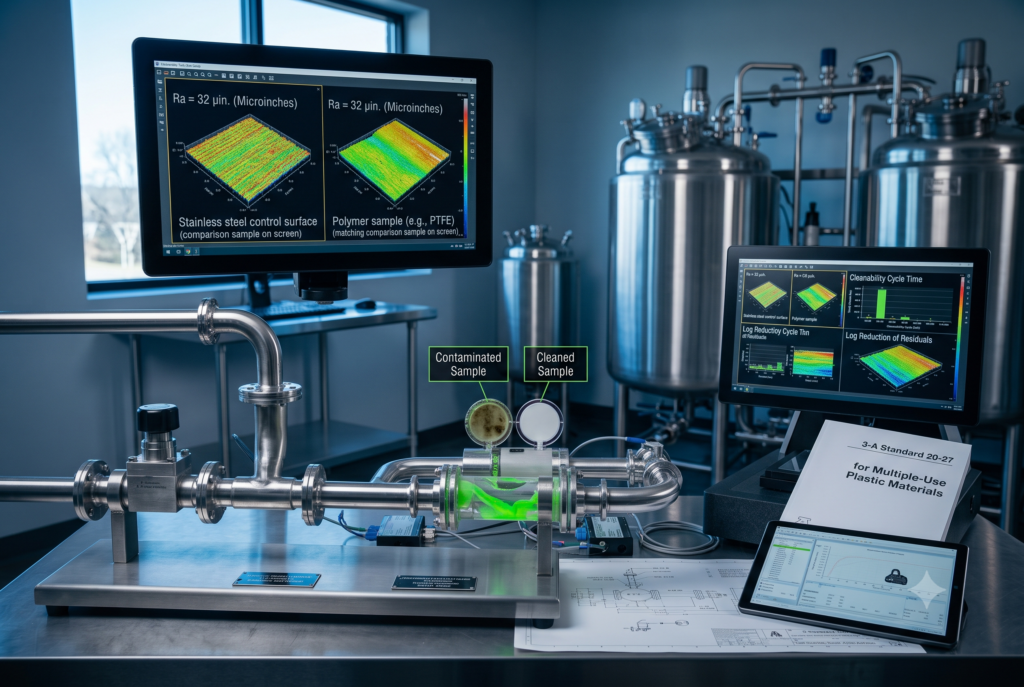
What Are 3-A Sanitary Standards?
3-A Sanitary Standards are stringent design and fabrication guidelines established by 3-A Sanitary Standards, Inc. (3-A SSI). They dictate how equipment used in the food, dairy, beverage, and pharmaceutical industries must be manufactured to ensure it can be easily cleaned, protects against contamination, and withstands harsh clean-in-place (CIP) environments.
For QA/QC managers, product engineers, and material scientists, designing hygienic processing equipment is only half the battle. Proving to the market that your valves, pumps, or new polymer resins actually meet these hygienic baselines requires rigorous, third-party laboratory validation, followed by strict compliance audits.
Whether you are formulating a new PVDF plastic grade or manufacturing stainless steel centrifugal pumps, understanding exactly what independent laboratories and auditors look for is critical for getting your product to market and securing the coveted 3-A Symbol.
3-A SSI vs. FDA Food Contact: Navigating the Overlap
A common point of confusion is the overlap between FDA Food Contact approval (FCS) and 3-A Sanitary compliance. They are not the same thing, and most high-end food processing components must pass both to be commercially viable.
- FDA Food Contact Testing: This is a chemical migration test. It ensures that a material (like a plastic hose or rubber gasket) does not leach harmful chemicals, colorants, or heavy metals into the food product.
- 3-A SSI Testing: This evaluates the physical integrity and cleanability of the material. It guarantees that the plastic or metal won’t degrade under harsh acidic cleaning chemicals, won’t harbor bacteria in microscopic surface pits, and can be fully sanitized without being dismantled.
Common 3-A SSI Testing Requirements and Modern Metrology
When companies use Contract Laboratory to outsource their compliance testing, the requirements generally fall into strict testing categories. Sourcing a lab with advanced metrology equipment is critical to passing these evaluations.
1. Polymer & Plastic Validation (Standard 20-27)
Standard 20-27 applies to multiple-use plastic materials. You cannot simply claim a resin like virgin PTFE or PEEK is “food safe.” Contract laboratories must subject these plastics to physical testing to ensure they behave identically to a stainless steel control surface.
2. Elastomers & Rubber (Standard 18-03)
Used for O-rings, gaskets, and seals, Standard 18-03 dictates that the rubber must maintain its structural integrity. Labs test to ensure no swelling, cracking, or loss of tensile strength occurs after extended exposure to fats, cleaning acids, and high-temperature steam.
3. Surface Roughness (Ra) Measurement and Weld Integrity
To prevent bacterial adhesion, 3-A standards require product-contact surfaces to have a maximum surface roughness (Ra) of 32 microinches (0.8 micrometers). While standard profilometers were once the norm, modern laboratories now use 3D optical profilometry and white light interferometry to map the microscopic topography of materials with extreme precision. Labs also employ nondestructive testing (NDT), such as fluorescent dye-penetrant inspections, to verify that stainless steel welds are perfectly smooth and free of microscopic pits.
| Standard Focus | Target Materials | Key Laboratory Tests Required |
| 3-A 20-27 | Plastics & Polymers (PTFE, PVDF) | Cleanability Response, Cleanability Comparison, Product Treatment |
| 3-A 18-03 | Rubber & Elastomers (Gaskets) | Fat absorption, acid/alkali resistance, accelerated aging |
| 3-A 01-09 | Stainless Steel Storage Tanks | Surface roughness (Ra) mapping, dye-penetrant weld inspection |
| 3-A 02-12 | Pumps (Centrifugal, positive displacement rotary) | CIP fluid dynamics verification, drainability testing |
The Path to the 3-A Symbol: TPV, CCEs, and the EDTCF
A critical misconception is that passing a lab test automatically grants you the right to stamp your equipment with the 3-A logo. Prior to 2003, manufacturers could “self-certify.” Today, the process is strictly regulated. Obtaining a 3-A Symbol authorization certificate requires passing a comprehensive audit.
| Phase | Action Required | Key Deliverable |
| 1. Lab Testing | Contract an independent laboratory to test component materials (e.g., Cleanability Response). | Empirical testing data/reports |
| 2. EDTCF Compilation | Build a comprehensive file combining engineering drawings, manuals, and lab reports. | Engineering Design and Technical Construction File |
| 3. TPV Audit | Hire an independent certified conformance evaluator (CCE) to review the EDTCF and inspect equipment. | Third-Party Verification (TPV) sign-off |
| 4. Authorization | Submit the completed TPV documentation to 3-A SSI for final approval. | 3-A Symbol Authorization Certificate |
Finding the Right Laboratory for 3-A Compliance
Testing for 3-A Sanitary Standards requires highly specialized equipment. Not every lab has the 3D surface profilometers needed for strict Ra surface mapping, and many lack the specialized rigs required to run 500-hour CIP caustic wash simulations on elastomers.
If your lab reports are rejected by your CCE during the TPV audit, the entire certification process stalls.
Sourcing a lab capable of running precise cleanability response protocols on new polymers can take weeks of internal procurement time. Contract Laboratory simplifies this process by connecting you directly with independent, certified facilities that already have the exact capabilities you need to build a flawless EDTCF.
Need to validate your materials or equipment for an upcoming 3-A audit?
Let Contract Laboratory do the heavy lifting.
Outline your specific testing requirements—whether it’s Standard 20-27 for plastics or CIP drainability testing for pumps—and let capable laboratories come to you.
This article was created with the assistance of Generative AI and has undergone editorial review before publishing.
Frequently Asked Questions (FAQs)
No. While self-certification was permitted in the past, 3-A SSI eliminated this practice in 2003. Today, all equipment must undergo a Third-Party Verification (TPV) by a credentialed Certified Conformance Evaluator (CCE) to display the 3-A Symbol.
3-A Sanitary Standards apply to the design and fabrication of individual pieces of equipment, like a pump, valve, or plastic sheet. 3-A Accepted Practices govern the design and installation of entire systems, like a complete dairy processing pipeline.
At the federal level, 3-A certification itself is not legally mandatory in the US, but it is heavily referenced by state regulators, the FDA, and the USDA. In practice, most major food, pharmaceutical, and dairy processors will not purchase equipment unless it carries the 3-A symbol to satisfy their internal Hazard Analysis Critical Control Point (HACCP) plans.
Plastics must be tested against 3-A Standard 20-27. You need to submit samples to an independent laboratory capable of running Product Treatment and Cleanability Comparison tests to prove the plastic can be cleaned as effectively as stainless steel without degrading. These results are then added to your EDTCF.