
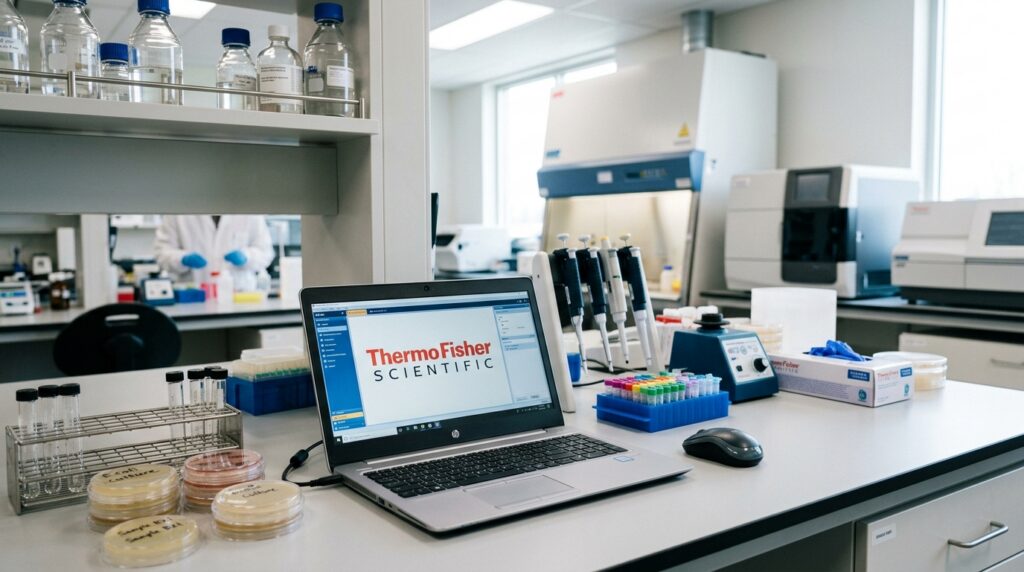
Thermo Fisher Scientific has announced the sale of its global microbiology business to Astorg, a pan-European private equity firm, for approximately $1.075 billion. The deal, disclosed on April 27, 2026, signals a significant shift in the ownership landscape for some of the most widely used microbiology testing products in clinical, pharmaceutical, and food safety laboratories — with meaningful implications for contract and independent testing labs that rely on these solutions. Read the full Thermo Fisher press release.
What’s Being Sold
The divested unit encompasses Thermo Fisher Scientific‘s antimicrobial susceptibility testing (AST) and culture media product lines—workhorses in the microbiology laboratory setting. These products are central to a wide range of workflows across three major application areas:
- Clinical diagnostics for identifying pathogens and guiding antibiotic therapy decisions. Antimicrobial susceptibility testing (AST) and pathogen detection are foundational to this work, directly informing treatment decisions and supporting global efforts to combat antimicrobial resistance (AMR).
- Pharmaceutical manufacturing, particularly sterility testing, environmental monitoring, and QC microbiology. Culture media are critical to each of these validated workflows, and any change to qualified supplier documentation will require laboratory attention.
- Food safety testing, for culture-based detection of microbial contaminants per FDA food safety and other regulatory requirements. For more on challenges in this space, see Contract Laboratory’s guide to food microbiology testing.
The business generated $645 million in revenue in 2025 and was part of Thermo Fisher’s Specialty Diagnostics segment. It will be relaunched as an independent, privately held company under Astorg’s ownership, with the transaction expected to close in the second half of 2026.
Who Is Astorg?
Astorg is a Luxembourg-headquartered, pan-European private equity firm with a track record of acquiring and growing specialized life science and healthcare businesses. Rather than folding the acquisition into a larger conglomerate, Astorg has indicated it plans to build the microbiology business as a standalone platform, pursuing organic growth and strategic add-on acquisitions to expand the portfolio. For contract labs, this means the business’s brand identity and product lines are likely to continue operating, though under a new parent and potentially new commercial structures over time.
Implications for Contract and Independent Testing Laboratories
For contract laboratories that rely on Thermo Fisher microbiology products in their daily operations, the near-term message from both parties is business continuity. Thermo Fisher emphasized a commitment to a smooth transition, and Astorg’s stated strategy focuses on strengthening — not disrupting — the existing platform.
That said, labs should be attentive to several practical considerations as the deal progresses toward its anticipated H2 2026 close:
- Supply chain and vendor relationships: Account managers, contracts, and distribution channels may eventually shift under new ownership. Labs currently sourcing culture media or AST consumables from Thermo Fisher should proactively confirm supply continuity agreements ahead of close.
- Regulatory documentation and supplier qualification: Sterility testing, USP <62> microbial testing, and other accredited workflows are often tied to specific lot records and supplier qualifications. Labs should monitor for any changes to Certificate of Analysis formats or regulatory filings tied to the brand transition.
- Potential portfolio expansion: With private equity (PE) backing and a mandate to grow through M&A, the new independent entity may expand into adjacent microbiology testing categories, potentially broadening product and service offerings available to contract lab customers over time.
- Pricing dynamics: A newly independent, PE-backed platform may revisit its commercial model. Pricing structures, volume discounts, and service agreements are worth reviewing as the new entity establishes its market identity. Labs engaging third-party microbiology testing providers may find value in benchmarking alternative suppliers during this transition period.
- Method and media validation: Labs using Mueller-Hinton agar or other standardized culture media for AST should verify that reformulation or rebranding does not trigger revalidation requirements under CLSI or EUCAST standards.
Why Is Thermo Fisher Selling?
Thermo Fisher’s CEO Marc N. Casper described the deal as reflecting the company’s active management of its portfolio, with the proceeds earmarked to create shareholder value. This is consistent with a broader trend among large life science conglomerates: divesting profitable but slower-growth or lower-margin segments to redeploy capital into higher-growth areas such as biopharma services, genomics, and laboratory automation.
With annual revenue exceeding $45 billion, Thermo Fisher is streamlining its portfolio around its highest-growth engines— and while culture media and AST products are essential to laboratory operations, they represent a more commoditized and mature segment relative to the instrument and biopharma services businesses Thermo Fisher is doubling down on.
See the full investor press release for financial details.
The Bigger Picture for Microbiology Testing
This transaction is part of a wider realignment happening across the life science tools and diagnostics industry. As large multinationals focus on core growth platforms, specialized business units are increasingly being spun out or acquired by PE firms with a mandate to build them into category leaders.
For organizations that outsource microbiology testing, including challenge testing, pathogen detection, and sterility assurance, this shift may ultimately produce more nimble, specialized vendors competing for their business. That could expand sourcing options and drive innovation in service offerings over the medium term.
Contract Laboratory connects organizations with accredited microbiology testing laboratories worldwide. If your lab is re-evaluating its supplier relationships in light of this transaction, explore our network of qualified contract microbiology testing providers to find the right partner for your testing needs.
Source: Thermo Fisher Scientific press release, April 27, 2026. Contract Laboratory monitors developments across the contract testing and laboratory services industry.