
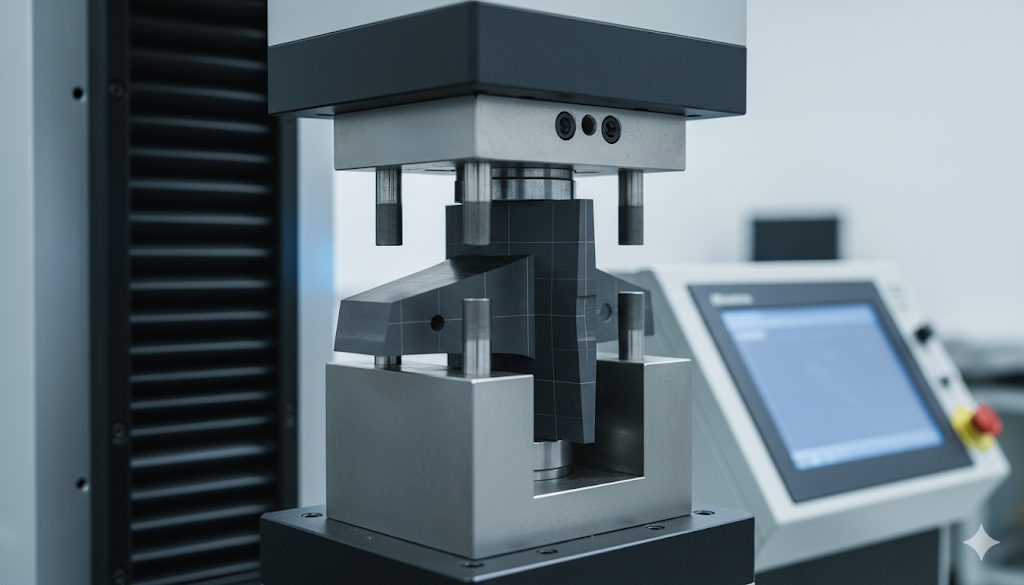
Advanced ceramics and composites—materials like silicon carbide, zirconia, alumina, and ceramic matrix composites (CMCs)—are the unsung heroes operating at the extremes of modern engineering. They provide solutions where conventional materials fail, offering superior hardness, extreme temperature resistance, chemical inertness, and unique electrical characteristics. Components made from these materials power spacecraft, insulate high-voltage electronics, and form wear-resistant parts in bio-implants. The high cost and critical nature of their applications make advanced ceramic component testing absolutely indispensable. Manufacturers rely on precise verification of material properties like thermal conductivity and electrical insulation to guarantee reliability. This rigorous testing minimizes failure risk in high-stress environments, ensuring the materials meet precise design specifications. This comprehensive article delves into the specialized testing themes required to certify the performance and reliability of these high-tech components.
Mechanical Testing: Verifying Advanced Ceramic Component Strength and Integrity
Unlike traditional materials, advanced ceramics and their composites exhibit high strength and hardness but can be sensitive to defects under tensile or impact loads. Advanced ceramic component testing must precisely quantify fracture toughness and mechanical endurance to predict performance under operating stress. This is particularly crucial for ceramic matrix composites (CMCs) used in aerospace turbine blades.
Specialized Mechanical Testing Methods:
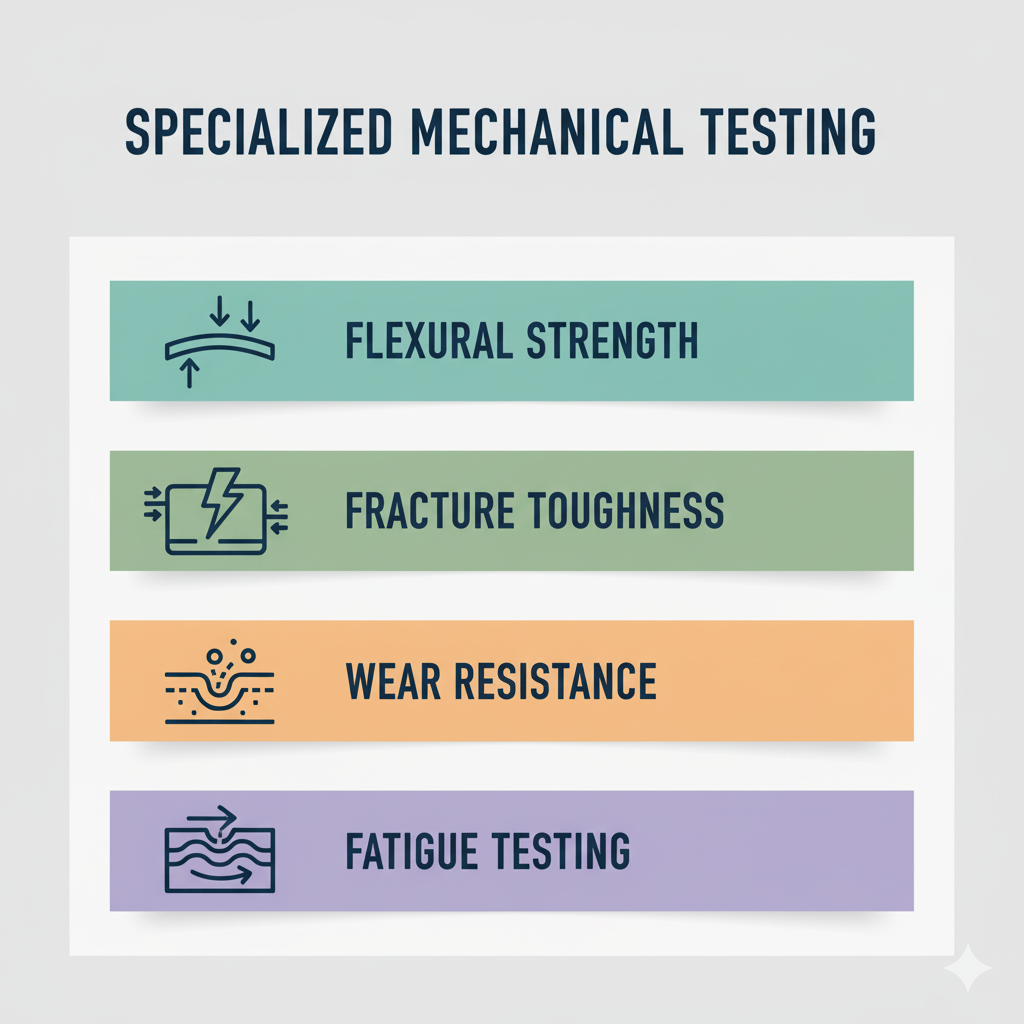
- Flexural Strength (Modulus of Rupture – MOR): Because ceramics are brittle, tensile tests are less reliable. The standard measure of strength is the three- or four-point bending test (MOR), which measures the stress required to cause fracture. This test provides a direct measure of the material’s structural integrity.
- Fracture Toughness (KIC): This fundamental material property measures a ceramic’s resistance to crack propagation. Testing typically involves introducing a controlled, sharp crack into the material and measuring the stress intensity required to make it grow. High KIC values are essential for impact-resistant applications.
- Hardness and Wear Resistance: Tests like Vickers or Rockwell hardness assess the material’s resistance to plastic deformation from indentation. Wear resistance (e.g., pin-on-disk testing) measures material loss when the component is subjected to friction against another surface, crucial for bearings and seals.
- Fatigue Testing: For components in dynamic systems, fatigue tests (often involving cyclical loading at high temperatures) determine the number of cycles a material can withstand before failure. This is vital for guaranteeing the longevity of high-performance parts.
For ceramic matrix composites, interlaminar shear strength and tensile strength must be tested parallel and perpendicular to the fiber layup to verify the composite structure’s integrity and predict anisotropic performance.
Thermal Analysis: Testing Thermal Conductivity and High-Temperature Material Properties
Advanced ceramics are often chosen for their superior performance in high-heat environments. Verifying their ability to handle, insulate, or conduct heat is a key component of advanced ceramic component testing. These material properties directly influence energy efficiency and component lifespan in furnaces, engines, and heat exchangers.
Key Thermal Characterization Tests:
- Thermal Conductivity (λ): This test measures the rate at which heat is transferred through the material. Depending on the application, a component may require either extremely high thermal conductivity (for heat sinks) or extremely low thermal conductivity (for thermal barrier coatings). Methods like Laser Flash Analysis (LFA) are commonly used to obtain precise values.
- Thermal Expansion (α): Measured using a dilatometer, this test determines how much the ceramic expands or contracts with temperature changes. Poorly managed thermal expansion can lead to dangerous internal stresses when a ceramic part is joined to a metal component.
- Thermal Shock Resistance: Measures the material’s ability to withstand rapid temperature changes without fracture. Samples are cycled quickly between hot and cold extremes. Materials with high strength and low thermal expansion coefficients typically exhibit better resistance to thermal shock.
- High-Temperature Creep: For components under continuous load at high temperatures (e.g., turbine blades), creep testing determines the material’s susceptibility to permanent deformation over time. This is a vital durability testing protocol for long-life systems.
Accurate data on thermal conductivity and expansion ensures that the ceramic component will not fail or cause secondary stress to other parts when operating in extreme thermal gradients.
Electrical Testing: Assessing Dielectric Strength and Electrical Insulation
Many advanced ceramic component testing requirements stem from the material’s role as a semiconductor, insulator, or dielectric in electronic systems. High-purity ceramics like alumina or silica are essential for high-voltage and high-frequency applications where precise electrical insulation and minimal energy loss are required.
Testing Protocols for Electrical Performance:
- Dielectric Strength and Breakdown Voltage: This is the maximum electrical field strength (voltage per unit thickness) that an insulating material can withstand without electrical breakdown. This is the fundamental measure of electrical insulation capability for high-voltage applications.
- Dielectric Constant and Loss Tangent (tanδ): These properties are critical for microwave and high-frequency communication components. The dielectric constant measures a material’s ability to store electrical energy, while the loss tangent quantifies the energy dissipated as heat (signal loss). Minimizing the loss tangent is crucial for high-efficiency electronics.
- Volume and Surface Resistivity: Measures the material’s bulk resistance to electrical current. High resistivity values confirm superior electrical insulation and prevent leakage current.
- Conductivity and Resistance: For electrically conductive ceramics (e.g., silicon carbide heating elements), testing verifies the material’s ability to conduct electricity reliably at operating temperatures, ensuring consistent performance.
These analyses provide the quantitative proof that advanced ceramics meet the stringent demands of modern electronic, power, and communication systems.
Compositional Analysis: Purity Profiling and Material Properties Verification
The final performance of an advanced ceramic component is heavily dependent on its initial composition, phase purity, and homogeneity. Even minute variations or contaminants can drastically alter the final material properties, leading to mechanical or electrical failure. Advanced ceramic component testing must include rigorous compositional analysis.
Methods for Compositional Verification:
- X-Ray Diffraction (XRD): XRD is used to identify the specific crystalline phases present (e.g., alpha vs. beta silicon carbide). Phase analysis is essential because different phases of the same ceramic can have radically different material properties (e.g., strength and toughness).
- Scanning Electron Microscopy (SEM) and Energy-Dispersive X-ray Spectroscopy (EDS): SEM provides high-magnification images of the microstructure (grain size, porosity, defect structure), while EDS provides elemental analysis of specific areas or inclusions. This is crucial for verifying the integrity of the matrix and fiber interface in ceramic matrix composites.
- Porosity and Density Measurement: High-performance ceramics require near-theoretical density to achieve maximum strength and minimal permeability. Techniques like Archimedes’ method quantify bulk density and porosity, which correlate directly to mechanical integrity.
- Trace Impurity Analysis (ICP-MS): High-sensitivity methods like Inductively Coupled Plasma Mass Spectrometry detect trace elements that can act as contaminants, negatively affecting thermal conductivity or compromising electrical insulation at high operating temperatures.
Verifying the compositional integrity ensures that the material’s final material properties align precisely with the theoretical design, transforming high-tech specification into certified performance.
Advanced Ceramic Component Testing: The Path to Certified Reliability
The successful deployment of advanced ceramics and ceramic matrix composites in mission-critical roles—from aerospace components to medical devices—is entirely dependent on verifiable test data. Through rigorous advanced ceramic component testing, manufacturers can confirm fundamental material properties like flexural strength and fracture toughness, validate specialized characteristics such as thermal conductivity and electrical insulation, and verify compositional purity. Investing in accredited third-party laboratory services provides the objective, quantitative proof necessary to mitigate failure risks, secure regulatory approval, and deliver reliable, high-tech components capable of performing in the most demanding environments.
Submit a testing request today to secure project integrity with reliable, third-party laboratory verification.
FAQ
Ceramics are brittle and sensitive to small flaws. Tensile testing requires perfect alignment and often leads to premature failure at grips. Bending tests (MOR) are preferred in advanced ceramic component testing because they are simpler to execute and provide a more reproducible, quantifiable measure of flexural strength, which is a key material property.
Ceramic matrix composites (CMCs) require additional specialized testing to verify the fiber/matrix interface, including interlaminar shear strength, and often anisotropic testing to measure material properties in different directions relative to the fiber orientation. Standard advanced ceramic component testing focuses more on the homogenous bulk properties of the monolithic material.
Thermal conductivity testing is vital because the desired outcome depends on the application. A heat exchanger requires high thermal conductivity to move heat efficiently, while a thermal barrier coating requires very low thermal conductivity (superior electrical insulation) to protect the underlying structure from extreme heat.
Dielectric strength measures the material’s maximum electrical insulation capability. It determines the maximum voltage a ceramic insulator can handle before a catastrophic electrical breakdown occurs. This test is mandatory for power generation, high-voltage switching, and electronics applications to ensure safety and function.
This article was created with the assistance of Generative AI and has undergone editorial review before publishing.