
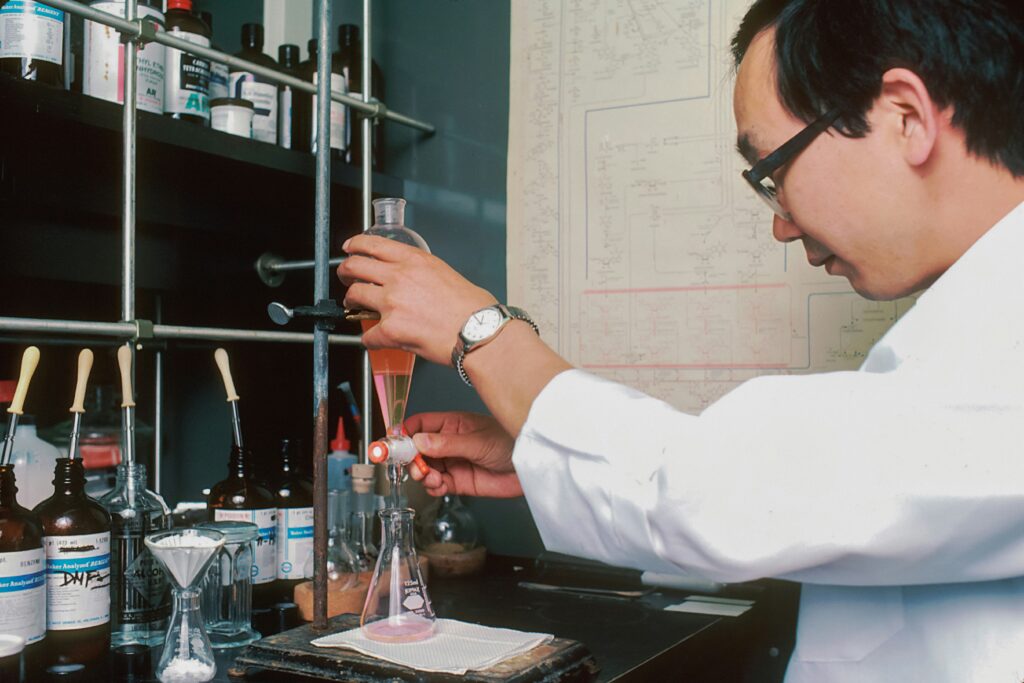
Chemistry testing underpins nearly every sector of modern life. It ensures that pharmaceuticals are safe, food products are authentic, water is clean, and materials perform as intended. From routine raw material checks to advanced analyses at parts-per-trillion levels, chemistry testing combines established methods with high-end instrumentation to answer critical scientific and regulatory questions.
While many organizations operate internal laboratories, others rely on outsourcing chemical testing to expert contract laboratories. Contract labs provide specialized expertise, ISO 17025 accreditation, and access to costly instruments, allowing companies to meet compliance requirements and scale testing programs without building additional infrastructure. To understand the opportunities in today’s testing market, it is important to look at the core techniques, sector-specific applications, emerging areas, and the broader outsourcing potential.
Core Techniques in Chemistry Testing
At the heart of chemistry testing are analytical techniques that enable scientists to detect, identify, and quantify compounds in diverse matrices.
- Chromatography (GC, HPLC, LC-MS/MS, GC-MS/MS) remains the workhorse for separating complex mixtures and measuring trace contaminants. These methods are indispensable for pharmaceutical impurity profiling, pesticide residue analysis, environmental volatile organic compounds (VOC) monitoring, and even flavor and fragrance characterization.
- Elemental Analysis techniques, such as ICP-MS, ICP-OES, and AAS, are crucial for quantifying metals at parts-per-million (ppm) to parts-per-trillion (ppt) levels. These methods support pharmaceutical elemental impurity compliance (ICH Q3D), heavy metal limits in cosmetics and food, and environmental monitoring of water and soil.
- Spectroscopy (FTIR, NMR, UV-Vis) provides structural and compositional information. FTIR helps identify functional groups, NMR elucidates molecular structure, and UV-Vis offers fast, reliable concentration and purity checks.
- Classical Wet Chemistry methods, including titrations, gravimetry, and colorimetry, may seem traditional, but they remain essential for compendial compliance in the USP and AOAC monographs and for routine quality control in raw material testing.
Together, these techniques form the scientific backbone of chemistry testing, enabling laboratories to support a range of industries.
Industry-Specific Applications
Different sectors rely on chemistry testing in unique ways, though the underlying need—scientifically valid, defensible results—remains the same.
- Pharmaceuticals and Biopharmaceuticals: Chemistry testing ensures drug safety and efficacy. Outsourced services often include potency assays, impurity profiling, stability studies under ICH Q1 guidelines, and extractables/leachables from packaging. For biologics, advanced tests, like glycosylation analysis and peptide mapping, are increasingly in demand.
- Environmental Testing: Laboratories support compliance with EPA, ISO, and local requirements through testing of water, soil, air, and hazardous waste. PFAS monitoring via LC-MS/MS, VOCs analyzed by GC-MS, and heavy metals measured by ICP-MS are now routine. As environmental concerns grow, contract labs provide the capacity and accreditation needed for defensible data.
- Food Chemistry: Chemistry testing verifies nutritional content, detects contaminants, and protects against fraud. Contract labs perform pesticide residue analysis, heavy metal screening, mycotoxin detection, and shelf-life studies. Authenticity testing—such as isotopic analysis or DNA barcoding—helps ensure consumer trust in global food supply chains.
- Industrial and Materials Chemistry: Manufacturers depend on chemistry testing to verify product quality and investigate failures. From gel permeation chromatography (GPC) for polymer molecular weight to XPS and SEM-EDS for thin films and alloys, these services underpin the ASTM, ISO, and REACH compliance while also driving innovation.
- Cosmetics and Personal Care: With the MoCRA implementation, chemistry testing has become a regulatory requirement in the US. Common analyses include heavy metal screening, preservative efficacy testing, stability studies, and ingredient verification, ensuring both compliance and consumer safety.
Across each sector, chemistry testing provides assurance that products meet specifications and comply with increasingly complex regulatory frameworks.
Specialized and Emerging Areas in Chemistry Testing
The field is rapidly evolving, with new areas of testing gaining importance as science and regulation advance. The following are a few avenues labs can leverage:
- Nanomaterials: Particle size distribution (DLS, TEM), surface area (BET), and surface chemistry (XPS) testing are essential for evaluating engineered nanoparticles in coatings, electronics, and medical applications. The EU REACH and OECD guidelines are expanding requirements for nanomaterial characterization.
- PFAS: Ultra-trace analysis of PFAS using HRMS and LC-MS/MS is one of the fastest-growing testing areas, driven by new EPA Maximum Contaminant Levels and REACH restrictions. Demand spans water, textiles, packaging, and cosmetics.
- Microplastics: FTIR and Raman microscopy are used to identify polymer types and particle sizes, often down to the micron-scale. Food, bottled water, and environmental matrices are common testing targets as global regulators consider mandatory microplastics monitoring.
- Biodegradability: The OECD 301/302 protocols assess chemical breakdown under aerobic and anaerobic conditions, supporting eco-label claims for bioplastics, surfactants, and green chemistry innovations. The EU’s Ecodesign for Sustainable Products Regulation (ESPR) is reinforcing demand for these tests.
- Forensic Chemistry: Advanced techniques such as isotopic ratio mass spectrometry (IRMS) and trace elemental fingerprinting are used for counterfeit drug detection, food authentication (e.g., honey, olive oil), and contamination source identification in environmental or industrial disputes.
These specialized areas highlight how chemistry testing is expanding beyond routine quality control into the front lines of regulatory enforcement, sustainability, and consumer safety.
Trends Shaping the Chemistry Testing Landscape
Several key forces are shaping demand for chemistry testing globally:
- PFAS and Microplastics: New contaminants driving ultra-trace detection requirements.
- Sustainability and Green Chemistry: Rising demand for biodegradability and lifecycle testing.
- Automation and Digitalization: Robotics, high-throughput platforms, and LIMS streamline workflows and turnaround times.
- Regulatory Expansion: Stricter requirements under MoCRA, ICH Q3D, EU REACH, and EPA MCLs create new testing needs.
- Globalized Supply Chains: Independent verification is increasingly required to ensure quality and authenticity across international markets.
These trends point toward a more regulated, data-driven future where accredited chemistry testing plays a central role.
Outsourcing Potential for Contract Laboratories
While many organizations perform basic testing in-house, a majority of them across industries often outsource specialized and/or high-volume chemistry analyses to contract labs. The drivers include:
- Capital efficiency: Instruments such as ICP-MS, NMR, and HRMS are expensive to purchase and maintain.
- Expertise: Advanced methods require experienced analysts and validated workflows.
- Accreditation: ISO 17025 and GLP/GMP compliance is often more cost-effective through third-party labs.
- Scalability: Outsourcing provides capacity during regulatory submissions, audits, or seasonal spikes in demand.
- Independence: Third-party results carry greater weight with regulators and consumers, providing impartial validation.
For contract laboratories, investing in chemistry testing capabilities positions them as trusted partners across industries facing rising compliance burdens and scientific challenges.
Expanding Chemistry Testing Services?
Independent testing laboratories that combine strong technical expertise with regulatory compliance, accreditation, and the agility to adopt emerging methods are best positioned to meet industry needs. Ultimately, chemistry testing is more than a regulatory requirement—it is a critical safeguard for public health, product quality, and environmental protection.
If you’re a chemistry testing lab and are looking to expand your business, register your lab on the new Contract Laboratory platform to connect with requester clients worldwide.
Frequently Asked Questions (FAQs)
1. Why do companies outsource chemistry testing instead of keeping it in-house?
Maintaining advanced instruments such as LC-MS/MS or ICP-MS and hiring skilled staff is expensive. Outsourcing offers accredited, expert services without capital investment.
2. Which industries outsource chemistry testing most often?
Pharmaceuticals, environmental monitoring, food and beverage, cosmetics, and advanced materials are the top sectors.
3. What standards govern outsourced chemistry testing?
The ISO 17025 for lab accreditation, the FDA/ICH guidelines for pharma, the EPA methods for environment, Codex Alimentarius and the EFSA standards for food, the OECD 301/302 for biodegradability, and the MoCRA for cosmetics.
This article was created with the assistance of Generative AI and has undergone editorial review before publishing.