
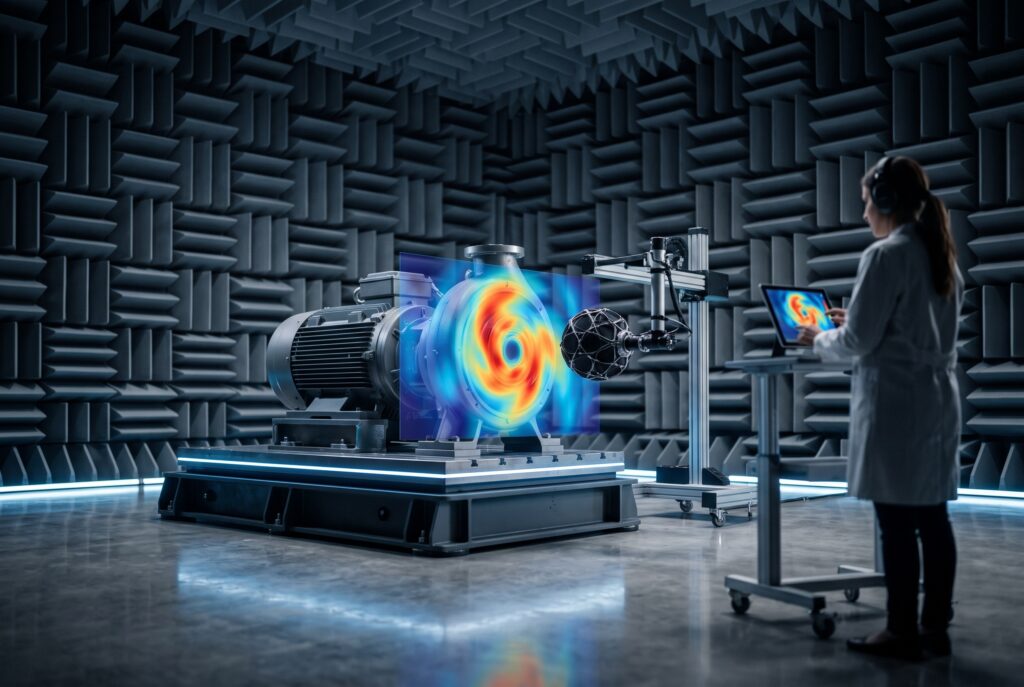
Sound is an unavoidable byproduct of mechanics, but its management dictates product viability. High-quality acoustics indicate precision engineering; unmitigated noise poses severe environmental and occupational hazards. From consumer appliances to heavy industrial machinery, measuring and controlling sound is a mandatory phase of product development and regulatory compliance.
Acoustic testing requires distinct terminology and highly controlled physical environments to yield accurate data.
- Acoustic Testing: The broad scientific study of sound generation, propagation, and reception.
- Noise Testing: The specific measurement of unwanted, disruptive, or mechanically harmful sound emissions.
- Noise, Vibration, and Harshness (NVH): The evaluation of acoustic comfort and tactile feedback. This metric is primarily applied in automotive, aerospace, and heavy machinery design to assess user experience.
Essential Metrics
- Decibels (dB) and A-weighted decibels (dBA): While dB measures raw sound pressure, dBA adjusts the measurement to correlate with the frequencies the human ear actually perceives.
- Sound Power vs. Sound Pressure: Sound Power is the total acoustic energy a source emits, which remains constant regardless of the environment. Sound Pressure is the acoustic force measured at a specific distance from the source, which changes based on room size, distance, and acoustic reflections. Laboratories measure pressure to calculate power.
Commonly Used Acoustic Testing Environments
To capture pure acoustic data, laboratories utilize specific room designs:
- Anechoic Chambers: Rooms completely lined with sound-absorbing fiberglass or foam wedges (a “free-field” environment). They prevent any sound waves from reflecting off the walls, floor, or ceiling.
- Hemi-Anechoic Chambers: Rooms with sound-absorbing walls and ceilings but a solid, acoustically reflective floor. This mimics real-world conditions for heavy machinery, vehicles, and appliances that operate on solid ground.
- Reverberation Rooms: The opposite of an anechoic chamber. These rooms feature hard, non-parallel surfaces designed to reflect sound evenly, allowing engineers to measure how well specific materials absorb sound.
Key Industries and Regulatory Frameworks
Testing requirements vary heavily based on the end-user and the operational environment.
1. Consumer Products and Toys (ASTM & ISO)
Preventing auditory damage in children and ensuring household appliances meet baseline comfort expectations drives consumer noise testing. Products that emit sound—intentionally or mechanically—must remain below specific decibel thresholds to reach store shelves.
Regulatory Focus: ASTM F963 establishes strict limits on continuous and impulse noises for toys. Equivalent ISO standards apply to global markets.
2. Automotive and Aerospace (SAE & UNECE)
Automotive acoustic engineering has two primary directives: Minimizing cabin noise (NVH) for passenger comfort and complying with exterior “pass-by” noise regulations designed to curb urban noise pollution. The transition to electric vehicles (EVs) has intensified this testing, as the lack of an internal combustion engine exposes tire and wind noise.
Regulatory Focus: SAE guidelines dictate interior and exterior noise measurement protocols, while UNECE regulations establish global baseline targets for vehicle emissions.
Explore how labs conduct NVH Testing under SAE guidelines
3. Occupational Health and Safety (OSHA, NIOSH, & WHO)
Prolonged exposure to industrial noise leads to permanent, noise-induced hearing loss (NIHL). Employers use acoustic testing to verify that factories, construction sites, and agricultural settings remain within legal exposure limits.
Regulatory Focus: OSHA and NIOSH mandate specific time-weighted averages (TWA) and permissible exposure limits (PEL) to calculate safe operational hours for workers around heavy equipment.
4. Medical Devices and Equipment (FDA & IEC)
Acoustic testing in the medical sector serves a dual purpose: Ensuring that critical, life-saving alarms are immediately recognizable over chaotic hospital background noise, and protecting patients from excessive mechanical noise during diagnostic procedures.
Regulatory Focus: The IEC 60601-1-8 dictates strict acoustic requirements for medical alarms—including specific frequencies, pulse patterns, and priority levels—ensuring they are easily distinguishable by clinicians. Additionally, heavy medical imaging equipment like MRI machines must undergo rigorous noise exposure testing to meet the FDA safety guidelines and protect patient hearing.
5. Environmental and Community Noise (EPA & ISO)
While occupational testing focuses on the noise generated inside a facility, environmental acoustic testing focuses on the sound leaving it. Manufacturers of outdoor equipment—such as commercial HVAC units, backup generators, and heavy construction machinery—must validate that their products will not cause facility operators to violate local zoning ordinances.
Regulatory Focus: ISO 1996 provides the definitive international framework for measuring and assessing environmental noise levels. Test data is used to ensure compliance with EPA guidelines, municipal property-line noise ordinances, and environmental impact assessments.
Standard Laboratory Acoustic Tests
When manufacturers submit products to a contract laboratory, they typically require one of the following standardized procedures:
- Sound Power Level Determination: Essential for drafting accurate product specifications, owner’s manuals, and CE marking compliance.
- Sound Transmission Loss (STL): Evaluates how effectively architectural barriers—such as drywall, commercial windows, and acoustic enclosures—block sound from passing from one room to another.
- Sound Absorption Testing: Measures how well soft materials (foam, ceiling tiles, automotive upholstery) reduce internal room echo, resulting in a noise reduction coefficient (NRC) rating.
- Vibration and Structural Testing: Often utilizing electrodynamic shaker tables, this test identifies the mechanical origins of airborne noise, pinpointing exact structural rattles, squeaks, and material resonances.
Modern Acoustic Measurement Tools
Standard microphones provide raw volume data, but modern laboratories employ advanced diagnostic hardware to map the exact source of an emission.
- Acoustic Cameras and Microphone Arrays: These tools use dozens of synchronized microphones to capture sound waves and overlay them onto an optical video feed. This creates a real-time “sound hologram” or heat map, allowing engineers to visually pinpoint mechanical leaks or localized whining.
- Binaural Recording Heads: Mannequin heads equipped with specialized microphones placed inside synthetic ear canals. This setup records and analyzes sound exactly as a human passenger or operator would perceive it spatially.
- Laser Vibrometry: Using non-contact lasers to measure microscopic surface vibrations that generate acoustic energy, useful for lightweight or highly sensitive components where attaching a physical sensor would alter the test results.
Sourcing the Right Acoustic Testing Laboratory
Selecting an acoustic laboratory requires verifying facility capabilities against your specific engineering needs.
- ISO/IEC 17025 Accreditation: This is the baseline requirement. ISO 17025 accreditation ensures the laboratory’s equipment is properly calibrated and its testing methodologies are legally defensible and globally recognized by regulatory bodies.
- Facility Sizing: Acoustic chambers vary significantly in size. A lab testing a commercial HVAC unit requires a massive hemi-anechoic chamber capable of handling heavy floor loads, whereas a consumer electronics test requires a much smaller enclosure.
- Data Delivery: Usable results require high-level post-processing. Request laboratories that provide comprehensive frequency spectrum analysis and actionable engineering data rather than basic pass/fail certificates.
Proactive acoustic testing mitigates regulatory delays, prevents costly manufacturing redesigns, and ensures end-user safety. Whether you are actively searching for a testing partner to validate a new product or looking to offer your facility’s acoustic capabilities to a broader market, Contract Laboratory bridges the gap.
If you require sound power validation, NVH analysis, or occupational noise measurement, submit a test request to connect with ISO-accredited acoustic testing facilities ready to support your project.
Are you an accredited facility with anechoic or NVH testing capabilities?
Receive inbound testing requests and expand your reach to global manufacturers actively seeking your diagnostic expertise.
This article was created with the assistance of Generative AI and has undergone editorial review before publishing.