

Regulatory frameworks governing environmental marketing are tightening worldwide. For B2B manufacturers, procurement officers, and product developers, self-declared environmental claims are rapidly transitioning from marketing assets into formal legal obligations. Organizations must now provide precise, verifiable data to substantiate any assertion regarding a product’s environmental footprint.
Two major European Union regulatory enforcement deadlines establish strict new baselines for product compliance across global supply chains:
- August 12, 2026: The EU Packaging and Packaging Waste Regulation (PPWR) begins general application. This regulation introduces immediate, harmonized laws across all member states. It requires formal technical documentation and an EU Declaration of Conformity (DoC) for packaging placed on the market.
- September 27, 2026: The Empowering Consumers for the Green Transition (EmpCo) Directive becomes enforceable. It bans generic environmental claims—such as “green,” “eco-friendly,” or “climate-safe”—unless the product demonstrates verified excellence through recognized frameworks. Crucially, EmpCo prohibits claims of climate neutrality or reduced impact achieved via external carbon offsetting. This forces companies to prove real-world reductions within their own value chains.
While these directives heavily target consumer-facing products, their impact cascades directly down the B2B supply chain. Consumer brands cannot validate their final products without demanding rigorous transparency from their raw material and component suppliers. To maintain market access, organizations use life cycle assessment (LCA) to build an auditable foundation for compliance.
What is a Life Cycle Assessment (LCA)?
An LCA is an objective, data-driven methodology used to quantify the cumulative environmental impacts of a product, material, or process throughout its entire lifespan. It is governed internationally by the ISO 14040 and ISO 14044 standards.
An LCA evaluates a product system from initial raw material extraction (“cradle”) through manufacturing, transport, and consumer use, up to its ultimate disposal, incineration, or recycling (“grave”).
Unlike a simple carbon footprint calculation, which focuses only on greenhouse gas emissions, a comprehensive LCA measures a broad spectrum of environmental vectors. These include water depletion, mineral resource scarcity, acidification potential, and aquatic ecotoxicity.
The Four Phases of an ISO-Compliant LCA
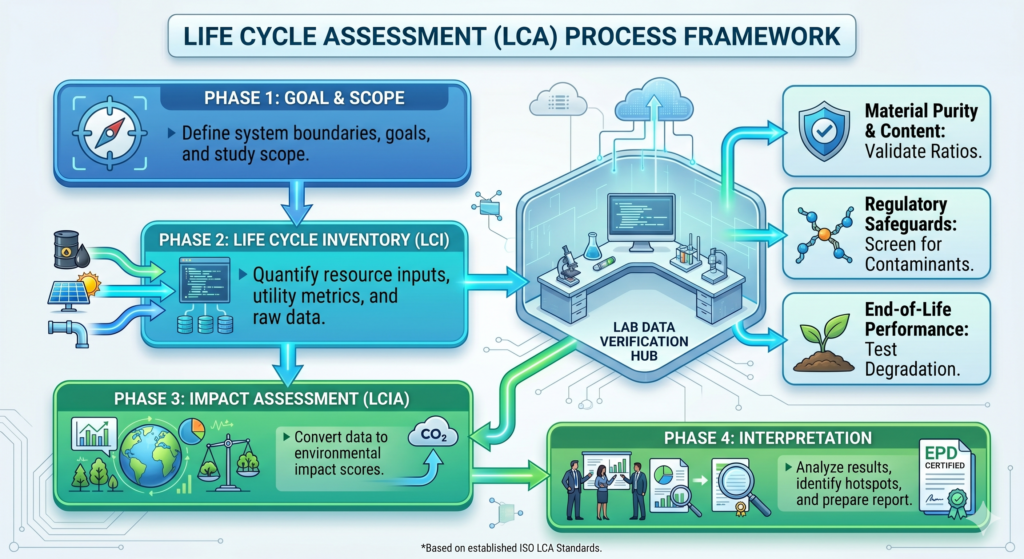
Executing an ISO-compliant assessment requires a structured, four-phase approach where each stage informs the next. Physical laboratory data acts as a critical anchor during this process, particularly when building the product inventory.
1. Goal and Scope Definition
This phase establishes the study’s boundaries and functional units. Practitioners determine exactly what is being measured and where the system boundaries end. For instance, a cradle-to-gate assessment tracks a material only until it leaves the factory floor, whereas a cradle-to-grave study follows the product through its entire disposal lifecycle.
2. Life Cycle Inventory (LCI)
This is the data collection phase, which serves as the operational backbone of the assessment. Companies compile an exhaustive ledger of all physical inputs and outputs. It tracks raw material quantities, water volumes, and energy consumption alongside any emissions released into the air, water, or soil.
3. Life Cycle Impact Assessment (LCIA)
The collected inventory data is processed using specialized characterization models to understand its real-world environmental impacts. This phase translates raw data—such as megajoules of electricity used or kilograms of waste produced—into standardized impact categories, such as the global warming potential (GWP) measured in CO2 equivalents.
4. Interpretation and Reporting
The final phase contextualizes the data to identify environmental hotspots within the manufacturing lifecycle. The findings are typically compiled into an independent report or an environmental product declaration (EPD), which B2B buyers frequently mandate during the procurement vetting process.
Cross-Sector Applications of LCA
The operational focus of an LCA varies significantly depending on the industry and the specific regulatory hurdles it faces:
| Industrial Sector | Primary LCA Focus | Regulatory & Market Drivers | Role of Laboratory Testing |
| Packaging & Consumer Goods | End-of-life performance, circularity, and post-consumer recycled (PCR) content validation. | EU PPWR (August 12, 2026); FTC Green Guides updates regarding environmental substantiation. | Verifying polymer biodegradation kinetics (ASTM D5338), measuring PCR resin purity, and screening for restricted chemicals. |
| Chemicals & Advanced Materials | Upstream extraction impacts, raw material footprinting, and chemical toxicity profiling. | REACH compliance updates; EU Eco-design for Sustainable Products Regulation (ESPR). | Analytical screening for heavy metals, leaching behavior assessments, and aquatic ecotoxicity testing. |
| Electronics & E-Mobility | Embodied carbon in complex global supply chains, battery lifespans, and rare earth mineral depletion. | EU Battery Passports (traceability mandates); global Right-to-Repair compliance. | Component durability testing, accelerated lifecycle evaluations, and non-destructive material characterization. |
Why Defensible LCAs Require Primary Laboratory Data
An LCA model is only as reliable as the data fed into it. Historically, many organizations relied heavily on secondary data—industry-average values pulled from static commercial databases. While useful for high-level estimates, secondary data introduces large margins of error that may face intense scrutiny under strict anti-greenwashing rules.
To survive a regulatory audit or independent third-party verification, compliance portfolios require primary data inputs. Physical laboratory testing translates assumptions into empirical verification for the life cycle inventory (LCI) stage.
Material Composition and Recycled Content
If a manufacturer claims a reduced carbon footprint based on the integration of post-consumer recycled (PCR) resin or bio-based feedstocks, the exact material ratios must be legally defensible. Analytical techniques like carbon-14 dating determine precise bio-based percentages, while differential scanning calorimetry (DSC) confirms polymer purity and the presence of recyclates.
Chemical Safety and Regulated Substances
Toxicity scores in an LCA cannot be estimated accurately using industry averages. Physical testing identifies the exact chemical makeup of a material. For example, the PPWR rules enforce strict thresholds for per- and polyfluoroalkyl substances (PFAS) in food-contact packaging, establishing limits such as 25 ppb for individual non-polymeric PFAS. Analytical testing quantifies these trace compounds, providing accurate data for the toxicity inventory of the LCA.
End-of-Life Degradation Kinetics
When an LCA models a product as biodegradable or compostable to justify a lower end-of-life environmental score, that performance must be demonstrated under standardized conditions. Laboratories operating under standards like EN 13432 or ASTM D5338 provide the empirical degradation curves required to legally defend those lifecycle assumptions.
Practical Action Plan for B2B Organizations
As compliance deadlines arrive, organizations should transition from passive tracking to active technical documentation. To secure market positioning, compliance and procurement teams should consider the following steps:
- Audit Current Environmental Claims: Review all active product data sheets, marketing materials, and digital labels. Flag and remove any vague, self-certified eco-claims that lack data validation.
- Identify Secondary Data Gaps: Evaluate existing carbon footprint and sustainability reports. Locate areas heavily reliant on secondary database averages and prioritize replacing them with primary data collected from your own supply chain.
- Establish Standardized Testing Protocols: Coordinate with independent third-party testing laboratories to validate material composition, durability, and chemical safety. Ensure all testing methodologies align directly with recognized ISO, EN, or ASTM standards to ensure international acceptability.
Grounding LCAs in physical laboratory data allows manufacturers to protect their market access, insulate their supply chains against greenwashing liabilities, and provide commercial partners with verifiable compliance metrics.
Sourcing Independent Laboratories for LCA Verification Data
Contract Laboratory assists compliance managers, quality control engineers, and product developers in locating certified analytical testing facilities globally.
Submit a request to secure the required technical capabilities. Or browse sustainability and environmental testing labs to validate your material specifications and support your environmental documentation.
This article was created with the assistance of Generative AI and has undergone editorial review before publishing.