
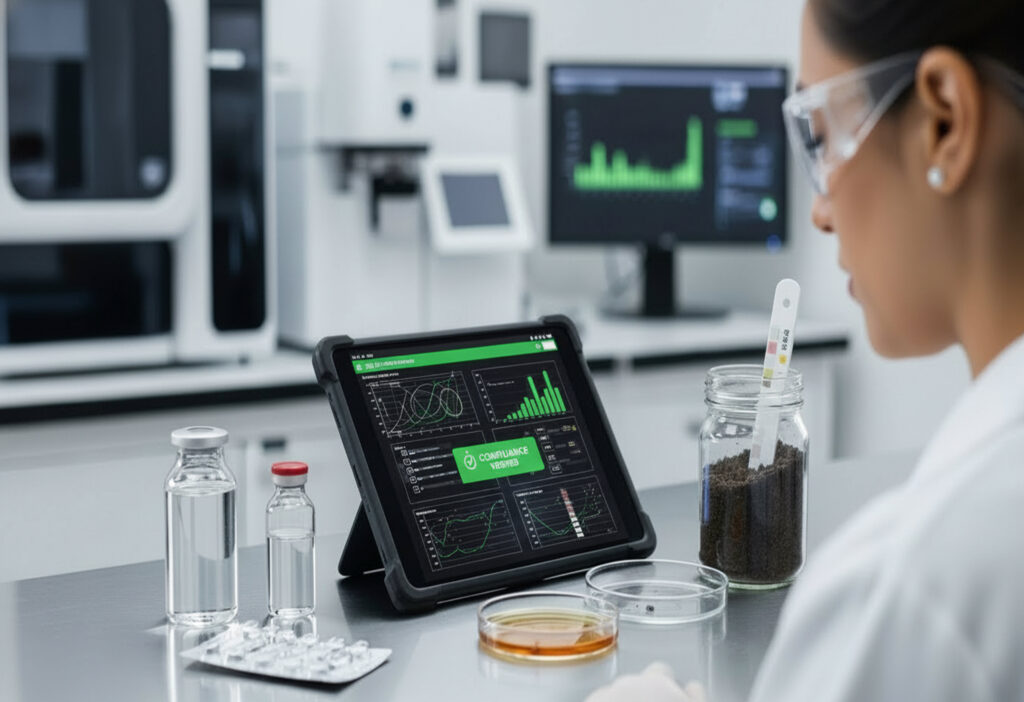
Testing, inspection, and certification (TIC) trends in 2025 focused on regulatory pressure, data defensibility, and compliance-driven testing demand across global industries. For contract laboratories, the year was defined by overlapping regulatory deadlines, expanded enforcement activity, and higher expectations for audit-ready documentation that could support regulators, customers, and third parties alike.
Rather than being driven by a single regulation or industry, 2025 reshaped the contract testing landscape through cumulative pressure across environmental, food, pharmaceutical, industrial, and supply chain testing.
How the Lab Testing Market Changed in 2025
Across nearly every sector served by Contract Laboratory, several forces converged in 2025 to reshape testing demand and laboratory operations.
Key TIC trends in 2025 included:
- Regulatory timelines increasingly driving when testing occurred, compressing demand into compliance-driven windows
- Greater emphasis on data defensibility and audit-ready documentation
- PFAS testing shifting from monitoring programs to compliance and enforcement-driven work
- Sustainability and supply chain claims requiring third-party verification
- Higher expectations for integrated quality systems and formal change control
These pressures affected laboratories not because of analytical limitations, but by how well data, documentation, and processes could stand up to scrutiny.
Environmental and PFAS Testing in 2025
Environmental testing was one of the most visibly impacted TIC segments in 2025. PFAS regulation, water quality standards, and chemical restrictions pushed environmental laboratories into more enforcement-facing roles.
Contract laboratories supporting environmental programs have adapted in several key ways.
- PFAS testing moved from broad screening to matrix-specific compliance testing across water, soil, packaging, textiles, and consumer products.
- Chain-of-custody procedures, contamination controls, and blank strategies received heightened scrutiny due to regulatory and legal exposure.
- Environmental data increasingly supported regulatory filings, recalls, and public disclosures rather than internal monitoring alone.
Environmental laboratories that treated reports as evidentiary documents—not just analytical outputs—were better positioned to support regulated clients.
Food Testing Under Greater Scrutiny
Food and beverage testing faced heightened regulatory and brand scrutiny in 2025 as food safety, labeling accuracy, and supply chain transparency came under closer review.
Contract food laboratories saw increased emphasis on the following.
- Expanded pathogen testing programs, particularly for ready-to-eat and high-risk products.
- Nutritional, allergen, and contaminant testing to support label claims, retailer requirements, and enforcement readiness.
- Clearer documentation, as food test results were reviewed more frequently by regulators, auditors, and commercial partners.
For food testing labs, defensible methods and clearly written reports became just as important as turnaround time.
Data Integrity in Pharmaceutical Testing
Pharmaceutical and biopharmaceutical testing continued to prioritize data integrity, method lifecycle control, and audit readiness throughout 2025.
Contract laboratories supporting drug development and manufacturing strengthened quality practices by:
- Producing validation and verification documentation that was complete, traceable, and reusable across submissions.
- Applying stricter change control to minimize regulatory and inspection risk.
- Supporting clients during audits with structured, easy-to-navigate evidence packages.
In regulated life science testing, documentation maturity increasingly defined laboratory value in the last year.
Clinical and Diagnostic Testing in 2025
Clinical and diagnostic testing operated under regulatory uncertainty in 2025, and that uncertainty flowed directly into laboratory operations.
Contract laboratories responded by:
- Designing documentation practices that could support evolving oversight expectations without repeated rework.
- Emphasizing performance verification, traceability, and method justification.
- Clearly communicating test limitations and appropriate use to regulated clients.
This reinforced the role of clinical laboratories as compliance partners rather than purely transactional service providers.
Consumer Products and Packaging Testing
Consumer product and packaging testing expanded in scope during 2025 as chemical compliance, sustainability, and restricted-substance regulations intensified.
Contract laboratories adapted by:
- Supporting global market-access requirements rather than single-region compliance.
- Addressing the intersection of packaging testing, food contact regulations, and environmental rules.
- Aligning reports clearly with regional regulatory frameworks to support audits and certifications.
Demand increased for laboratories capable of navigating cross-border compliance requirements.
Construction Materials Testing and Compliance
Construction materials and infrastructure testing in 2025 focused heavily on compliance assurance, public safety, and documentation.
Contract laboratories emphasized:
- Materials testing aligned with updated standards and project specifications.
- Clear documentation to support inspections, certifications, and dispute resolution.
- Consistent sampling and chain-of-custody practices for field-collected materials.
For construction testing labs, traceability and defensibility were critical for both compliance and liability management.
Mining and Metals Testing in 2025
Mining and metals testing continued to evolve as sustainability, resource accountability, and supply chain transparency gained importance.
Contract laboratories adapted by:
- Expanding analytical capabilities for critical minerals and industrial materials.
- Strengthening documentation to support ESG reporting and regulatory review.
- Ensuring sampling integrity and reproducibility across geographically distributed sites.
Strong quality systems became increasingly important in high-volume industrial testing environments.
Supply Chain and Product Certification Testing
Manufacturers relied heavily on third-party testing and certification due to global trade complexity and instances of supply chain disruption last year.
Contract laboratories supported supply chain compliance by:
- Providing testing to meet import and export requirements.
- Delivering documentation suitable for customs authorities, retailers, and regulators.
- Coordinating testing across regions and standards frameworks.
These services underscored the role of lab testing in enabling global commerce.
Key Takeaways for Contract Laboratories
Across all testing categories, several lessons emerged consistently, including:
- Compliance pressure increasingly originated from customers managing regulatory and reputational risk.
- Well-structured documentation reduced regulatory exposure across industries.
- Laboratories that could clearly explain how results would be used delivered greater value.
- Operational adaptability across sectors became a defining competitive advantage.
How Contract Labs Can Prepare for 2026
Preparing for 2026 means turning the lessons of 2025 into standard operating practice.
- Create a regulatory-aware operating calendar.
Map testing demand to known and emerging compliance deadlines across industries. - Standardize defensibility across services.
Repeatable documentation packages reduce risk for environmental, food, pharma, and industrial testing alike. - Formalize standards monitoring and change control.
Treat method updates as controlled events rather than reactive fixes. - Design reports for external review.
Ensure clear traceability between requirements, methods, and conclusions regardless of testing niche. - Invest in scalable quality systems.
Integrated quality practices support growth across multiple industries without fragmentation.
Looking Ahead
The TIC trends of 2025 showed that contract laboratories are no longer siloed by industry. Shared compliance expectations and documentation standards increasingly connect environmental, food, pharmaceutical, industrial, and supply chain testing. As regulatory pressure and global market complexity continue into 2026, laboratories that invest in adaptable systems and defensible data will be best positioned to grow.
If you are sourcing qualified testing laboratories or if you offer TIC services across any of these sectors, Contract Laboratory helps connect buyers and providers worldwide.
Submit a lab testing request or register your laboratory to stay visible and competitive in the year ahead.
This article was created with the assistance of Generative AI and has undergone editorial review before publishing.