
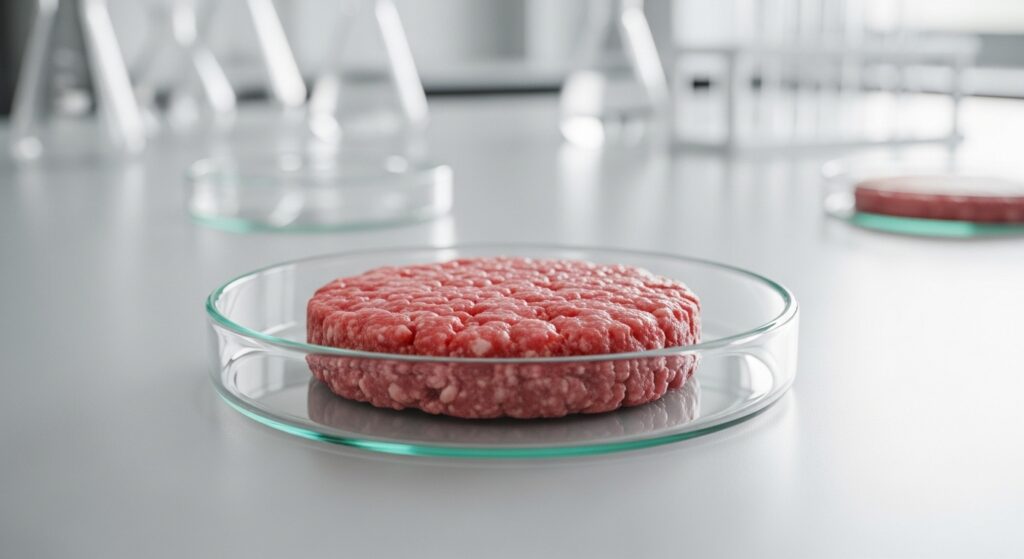
The transition of cell-cultured meat from a laboratory curiosity to a supermarket reality is imminent. However, as the industry scales from petri dishes to bioreactors, the regulatory spotlight is shifting. While traditional meat safety focuses on pathogens introduced during slaughter (like E. coli or Salmonella), the safety of cultivated meat hinges on the “soup” in which it grows.
For food tech startups and investors, the “novel food” status presents a unique hurdle: proving that the complex cocktail of nutrients, hormones, and antibiotics used to proliferate cells has been entirely removed from the final burger or nugget. Lab-grown meat validation is no longer just about proving it is meat; it’s about proving it is clean.
New Tech, New Risks: Beyond Traditional Pathogens
Traditional meat producers worry about contamination from the animal’s environment—feces, soil, and slaughterhouse hygiene. Cultivated meat producers, however, face a completely different set of biological variables. The primary concern shifts from external pathogens to internal stability and the purity of the inputs used to feed the biomass.
Bronte Ushaglyan, Food Scientist and President of United Food Labs, highlights the distinct safety landscape for this emerging sector:

“Cell-cultured meat introduces safety challenges that don’t exist in conventional meat production. One of the biggest is maintaining cell line stability over time; if the cells drift genetically or biologically, the final product can behave differently than expected. There’s also added risk tied to the growth media itself, including residual growth factors, hormones, or antibiotics that aren’t part of traditional meat processing and must be carefully controlled and verified.”
This “genetic drift” is a critical quality control parameter. Over multiple generations of replication, cells can mutate, potentially altering their nutritional profile, texture, or even safety. Continuous genomic sequencing is therefore required to ensure the cell line harvesting at Generation 50 is identical to the one banked at Generation 1.
The “Zero Residue” Mandate: Antibiotics & Hormones
In the proliferation phase, antibiotics are often used to prevent bacterial contamination in the nutrient-rich, warm environment of a bioreactor—conditions that are perfect for growing meat, but also perfect for growing bacteria. Similarly, recombinant growth factors (like IGF-1 or TGF-β) are essential for signaling the cells to divide and differentiate. However, these compounds are strictly regulated—and often banned—in the final consumer product. FDA and USDA frameworks for cultured meat place a heavy burden of proof on the manufacturer to demonstrate that these processing aids are removed before packaging.
The challenge is demonstrating that the downstream “harvest” and “wash” processes effectively flush these bioactive inputs out of the tissue. Ushaglyan explains the rigor required to prove safety to skeptical regulators and consumers:
“We test the final product using validated analytical methods to detect any antibiotic residues. Multiple samples are taken to ensure consistency across batches. Results are compared to regulatory limits to confirm they are below detectable or allowable levels. Certificates of analysis can be provided to demonstrate compliance. Transparent reporting and third-party verification help build consumer trust in the safety of the burger.”
Technical Validation: The Novel Food Safety Matrix
Validating a novel protein requires a comprehensive testing strategy that addresses both the process and the product. It is not enough to test the end product; the inputs (media) and the biological engine (cells) must also be validated.
| Testing Focus | Objective | Critical Methodology |
|---|---|---|
| Growth Media Analysis | Input Verification | HPLC/Mass Spec to verify the composition of the nutrient broth. |
| Residue Screening | Final Product Safety | High-sensitivity ELISA or LC-MS/MS to detect trace antibiotics/hormones. |
| Genetic Stability | Cell Line Consistency | Genomic sequencing to ensure cells haven’t mutated during replication. |
Why Third-Party Lab Testing is Critical for Approval
For the cultivated meat industry, consumer trust is not just a nice-to-have; it is a fragile currency that will determine the sector’s survival. The “Franken-meat” stigma remains a potent barrier to adoption, and a single substantiated report of “hormone-laden” lab meat could set the industry back by decades, triggering a PR crisis similar to the GMO backlash of the 90s. Furthermore, self-reported data from startups is often viewed with skepticism by regulators like the FDA and USDA, who require objective, unassailable evidence of safety. In this high-stakes environment, third-party testing serves as a critical firewall between a company’s internal optimism and the public’s demand for safety.
The Value of Independent Verification:
- Novel Food Dossiers: Regulators require robust, third-party data packages to approve new cultured meat products for sale.
- Consumer Transparency: A Certificate of Analysis (COA) from an accredited lab proves that your “antibiotic-free” claim is a chemical fact, not just marketing copy.
- Batch Consistency: As production scales from pilot plants to industrial factories, independent testing ensures that the safety profile remains consistent at scale.
Final Checklist: Is Your Cultured Meat Market-Ready?
- [ ] Residue Clearance: Have you validated that your washing process removes all growth factors and antibiotics?
- [ ] Genetic Stability: Are you regularly sequencing your cell lines to check for drift?
- [ ] Media Supply Chain: Do you have traceability for every component in your growth media?
- [ ] Regulatory Limits: Does your final product meet the MRLs (Maximum Residue Limits) for the target market?
The science of growing meat is revolutionary, but the science of testing it must be traditional, rigorous, and independent.
Is your cultivated meat ready for regulatory review? Visit Contract Laboratory to find a qualified laboratory, or Submit a Testing Request to get competitive quotes for your lab-grown meat validation needs today.